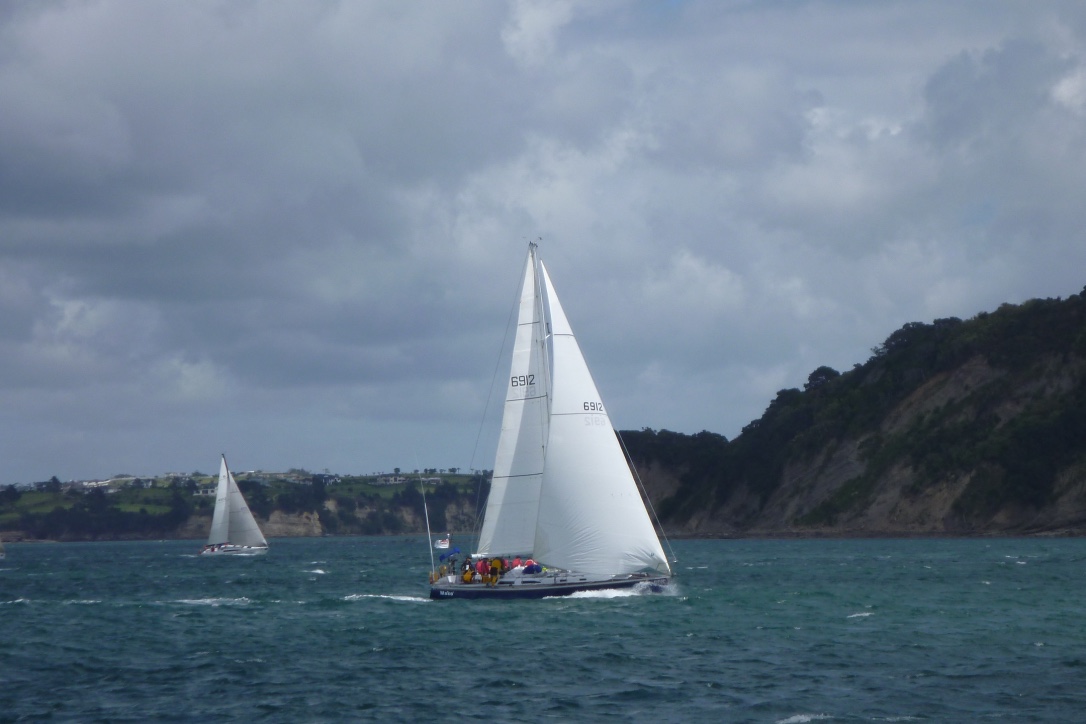
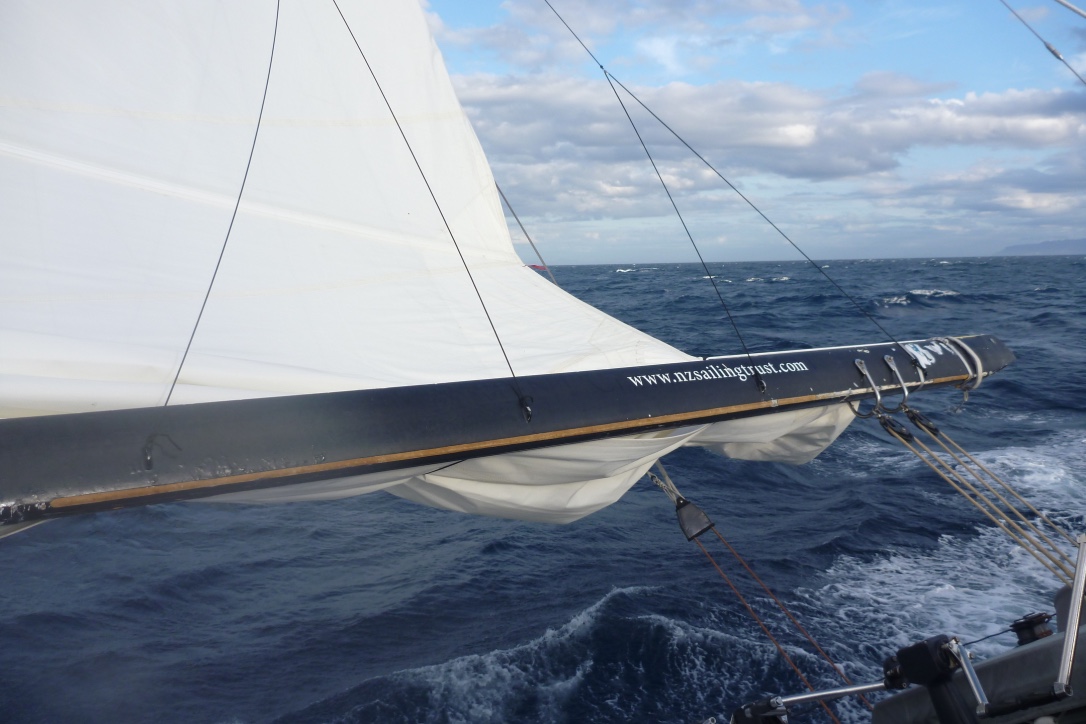
Yesterday my cousin Stephen Smith loaned me his OK Dinghy for the last races of the Onerahi Yacht Clubs Tuesday evening 'Twilight Series'. I raced in three back to back races and enjoyed myself immensely. I was the only OK dinghy sailor on the water and raced with others within the Laser fleet.
The wind was not as strong as last weeks series where I capsized 3 times sailing my Starling and didn't finish any races. This week, I completed all the races mainly because I found this bigger boat more suited to my size. It's a boat for someone of adult size and I found it more stable and easy to move around in. I found my weight suits this size; any movement within the cockpit doesn't alter the trim of the boat to the extent it does to the Starling.
I found the Ok Dinghy fast, relatively docile compared to the Starling and very forgiving in its manners. Despite its much bigger sail area, the rig can be easily tuned when sailing to suit the wind conditions. I found the hiking position much easier on my legs than on the Starling. This was a surprise to me as I thought that stacking out to windward for any length of time would be the deal breaker, but it wasn't nearly as difficult as I had imagined and I was able to stack out comfortably for lengthy periods of time.
A couple of weeks ago I went to Auckland and had a look at a couple of OK Dinghies for sale. Whether I purchase one is a question I will have to think very carefully about. Certainly the result of yesterdays sail has proved to myself that I am still capable of coping with one of these bigger boats.
Wednesday, December 16, 2015
Tuesday, December 15, 2015
The Nemesis Of 2000+ Years of Dualistic Theological Thinking
I listened to this Gordon Lightfoot song recently. I find it deeply, deeply haunting.
One of the verses in the song contains these lyrics:
"Does anyone know where the love of God goes
When the waves turn the minutes to hours?"
I think the implications of Lightfoots question is really the achilles heel and perhaps the nemesis of 2000 years of Christian thinking that lives in a theologically dualistic world. By dualistic I mean: We are here, and over there is a separate cosmic entity called God. Given the proclaimed nature of this God (Loving, forgiving, omnipotent and a worker of miracles) Christianity has never been able to answer the simple question - If God is omnipotent and loving why is there so much suffering in the world?
Put another way: What was God doing when he invented child cancer? Having an 'off day' ? If so, why doesn't he do something about it?
The way I deal with this question is to seek out wisdom from both the dualistic and non - dualistic traditions. By non- dualistic I mean: The idea that the universe and all its multiplicity are
ultimately expressions or appearances of one essential reality. This removes the reliance on the concept of a supposed 'Loving God' who ends up being a contradiction in terms.
So what is my personal path? My path requires the capacity to stay well away from organised religion, gurus, teachers, ashrams, monasteries and all other god awful monstrosities built on the ego and hubris of others. It is not a movement or a cause. It's the meeting of a few people, or one on one with a wise friend. The path requires reading, filtering what you read and then practising and integrating wisdom into everyday life. Living with paradox the wise ones gathering from both the non dualistic and the dualistic path advise that: Adhering to an impeccable moral code ( Buddhism, Christianity and other spiritual paths have lots of this stuff), meditation, mindfulness, pilgrimage, prayer, contemplation, practising " The Golden Rule" * and involving yourself in the world doing the things you love leads to personal transformation, wisdom and knowing beyond mere words. The crux of all of this is developing the capacity to transcend the 'ego' or the 'self' (selfishness). This process of personal transformation is a life long journey. Peace, insight and enlightenment is obtained during this transformational process by putting others first. In other words - Changing the world requires changing yourself first. Easy to say, hard to implement. That's why proselytising should be kept to a minimum. You should walk the talk - not talk the walk.
That's my Christmas message to the individual reader - If you like it, great, if you don't, disregard it instantly and seek out your own knowledge of your Self.
* The Golden Rule : http://www.religioustolerance.org/reciproc.htm
So what is my personal path? My path requires the capacity to stay well away from organised religion, gurus, teachers, ashrams, monasteries and all other god awful monstrosities built on the ego and hubris of others. It is not a movement or a cause. It's the meeting of a few people, or one on one with a wise friend. The path requires reading, filtering what you read and then practising and integrating wisdom into everyday life. Living with paradox the wise ones gathering from both the non dualistic and the dualistic path advise that: Adhering to an impeccable moral code ( Buddhism, Christianity and other spiritual paths have lots of this stuff), meditation, mindfulness, pilgrimage, prayer, contemplation, practising " The Golden Rule" * and involving yourself in the world doing the things you love leads to personal transformation, wisdom and knowing beyond mere words. The crux of all of this is developing the capacity to transcend the 'ego' or the 'self' (selfishness). This process of personal transformation is a life long journey. Peace, insight and enlightenment is obtained during this transformational process by putting others first. In other words - Changing the world requires changing yourself first. Easy to say, hard to implement. That's why proselytising should be kept to a minimum. You should walk the talk - not talk the walk.
That's my Christmas message to the individual reader - If you like it, great, if you don't, disregard it instantly and seek out your own knowledge of your Self.
* The Golden Rule : http://www.religioustolerance.org/reciproc.htm
Saturday, December 12, 2015
________________________ MERRY CHRISTMAS ________________________
Friday, December 11, 2015
The Mariner Project - Part 2
This is where perhaps the majority of engines in yachts around 30 feet (9metres) live - in the stern of the boat, under the cockpit and behind the companionway steps. 'Mariners' engine is no exception.
When I sailed recently in the Coastal Classic race on board 'Lion New Zealand' the skipper in his briefing remarked that " Lions marine toilets (she had 2) were made by people who hate sailors". Everyone laughed. The boat owners among us laughed a bit more wryly and would have added marine diesel engines to the list. Engines and toilets are extremely useful, but they also smell, can leak stuff everywhere, get blocked with stuff and sometimes decide not to work just when you need them the most. Of course us boat owners also have to take some responsibility and admit that things might work a lot more reliably if we did the routine maintenance.
This is 'Mariners' 11HP Arona Diesel engine. It is made by Fiat in Italy. It is mounted horizontally on the engine beds and power is transferred through a 'V' drive gearbox. This means that the engine has the fly-wheel facing the stern. The engine was installed when I launched the boat in 1979. It is an old simple single cylinder motor. The main problem over the years has been oil leaking mainly from the sump plate seals. Despite a drip tray underneath the engine, oil inevitably gets into the bilge with the resultant smell and mess.
On first inspection there are six problems I can see that require attention - there may be more.
1 - The engine will start and run, but doesn't pump any coolant water through the system. This may be a problem with the water pump or more likely the water jacket around the cylinder head may be clogged up with 35 years of metal 'scale' and rust.
2 - Salt water ingress has rusted the angle iron that the engine mounts are bolted to.
3 - Many parts of the engine are rusty and need attention.
4 - The engine mounts need renewing.
5 - Oil leaks from the engine sump plate continue despite a number of attempts to tighten the nuts up.
6 - The traditional dripping stern gland continues to drip and needs to changed to one of those new fangled non-drip varieties.
Today I had a long talk to Kurt on board his 40 foot Junk rigged schooner that is fitted with an Eco Friendly Electric Motor. More of that later!
When I sailed recently in the Coastal Classic race on board 'Lion New Zealand' the skipper in his briefing remarked that " Lions marine toilets (she had 2) were made by people who hate sailors". Everyone laughed. The boat owners among us laughed a bit more wryly and would have added marine diesel engines to the list. Engines and toilets are extremely useful, but they also smell, can leak stuff everywhere, get blocked with stuff and sometimes decide not to work just when you need them the most. Of course us boat owners also have to take some responsibility and admit that things might work a lot more reliably if we did the routine maintenance.
This is 'Mariners' 11HP Arona Diesel engine. It is made by Fiat in Italy. It is mounted horizontally on the engine beds and power is transferred through a 'V' drive gearbox. This means that the engine has the fly-wheel facing the stern. The engine was installed when I launched the boat in 1979. It is an old simple single cylinder motor. The main problem over the years has been oil leaking mainly from the sump plate seals. Despite a drip tray underneath the engine, oil inevitably gets into the bilge with the resultant smell and mess.
On first inspection there are six problems I can see that require attention - there may be more.
1 - The engine will start and run, but doesn't pump any coolant water through the system. This may be a problem with the water pump or more likely the water jacket around the cylinder head may be clogged up with 35 years of metal 'scale' and rust.
2 - Salt water ingress has rusted the angle iron that the engine mounts are bolted to.
3 - Many parts of the engine are rusty and need attention.
4 - The engine mounts need renewing.
5 - Oil leaks from the engine sump plate continue despite a number of attempts to tighten the nuts up.
6 - The traditional dripping stern gland continues to drip and needs to changed to one of those new fangled non-drip varieties.
Today I had a long talk to Kurt on board his 40 foot Junk rigged schooner that is fitted with an Eco Friendly Electric Motor. More of that later!
Thursday, December 10, 2015
The Mariner Project - Part 1
There are no more excuses. I now have a fully restored Starling sailing dinghy for exercise and diversion from the slings and arrows of outrageous retirement - so...... no more procrastination. I must now bite the bullet and get Mariners marine diesel engine either repaired or replaced. There is a lot more sailing to do before the letting go of 'Old Cold Nose' for the very last time by this old sailor.
I am toying with the idea of competing next year in the Auckland to Russell Coastal Classic, not as I did this year on board Lion New Zealand but on my very own beloved Mariner. So I have about eleven months to do this engine work and some others tweaks to the boat that will make her a little bit more fun to sail. Remember shipmates, sailing is serious fun .......... (Except when it's hell on earth - a howling gale, lee shore, moonless night, no bloody clue where you are, wet and seasick) ........ and serious fun is yee-hahingly good.
Wednesday, December 9, 2015
TWO D.N.F.s - ONE D.N.S. - OH WELL, WORSE THINGS HAPPEN AT SEA
The acronyms on race summary sheets DNF and DNS mean "Did Not Finish" and "Did Not Start" respectively. Two DNFs and one DNS sums up my second race outing yesterday evening. I was very excited before racing because it was blowing about 15 - 20 knots and I knew that I would be very competitive in this wind strength - and I was - until on three separate occasions in the first two races I capsized in spectacular fashion. To be fair to myself I have to say that I wasn't the only one suffering from multi - capsize syndrome as nearly everyone (except the winning Starling - which wasn't me! ) had a turn at getting thoroughly wet during the evening.
These photos are a bit deceptive as they don't really show how hard it was blowing, but it was fair funneling between Limestone Island and the mainland at Onerahi.
In the first race I was second to the top mark close behind a very skillful and accomplished teenage girl who always sails superbly. Downwind she really showed her skills by planing away in a shower of spray and gybing skillfully back onto what was a flat run to the bottom mark. My attempts to follow suit had me capsizing twice in a row. On both occasions the centerboard came out of the centerboard case and started to float away. I spent a lot of time trying to get it back in its slot so that I could heave on it and right the boat again.
In the second race, again I was doing very well only being pipped to the first mark by a whisker - but then again while sailing flat off downwind I came off a wave with the boat rolling to windward, over corrected and ended up in the tide again. This time I ended up under the boat with the main sheet wound around my neck and the deck banging on my head. Again the centerboard had fallen out and I spent a lot of time getting it back into the the centerboard case. By the time I got back into the boat for a third time I was pretty exhausted and decided to call it a day.
BUT - as I sailed back to the club house to the beer and barbecued sausages I hardly felt hard done by. The water was very pleasant to capsize into as it is warmed while flowing into Whangarei Harbour over several large sand banks that have been baking in the sun all day. Also, in this big wind memories came flooding back from my early sailing years as I felt again the joy of small boat sailing: Thrashing to windward, then planning off downwind in a flurry of spray and wind - very, very, very good for this old buggers soul I can tell you.
LESSONS LEARNED:
1 - "Always wear a life jacket". Wise words. I would have drowned without one.
2 - I am showing my age. Hiking out for long periods of time at 64 years of age is very taxing. I need not just the set of compression pads to protect the underneath of my thighs, I also require a set for my calf muscles.
3 - The boat requires another self bailer. In these choppy conditions I had water coming green over the bow and filling the cockpit.
4 - I need a piece of shock cord (something that all Starlings have - something I had overlooked) to hold the center board in place when capsized.
5 - I need to make sure that I do a thorough boat inspection before launching. I failed to see that I hadn't re-tied the hiking straps back up with shock cord which made getting my feet under the straps harder after each tack.
6 - "She'll be right" is not good enough - I thought the two loose sail battens in the mains'l that I knew required new elastic in the sail pocket (to hold suitable tension on them) would be ok. But in this full sail breeze one of them popped out when the sail was flogging in the wind. I took the sail into 'Calibre Sails' today to get fixed.
7 - My little Starling looks beautiful in all her varnished glory - BUT - she is also very slippery to work in. I slide like hell all over my beautiful varnished cockpit floor slats LOL and the deck isn't much different. Many racing yachts have non skid tape or painted out patches in high use areas - But I know all of this - My keeler Mariners' deck and cockpit are all painted out in non skid paint. I think I will have to do something about that if I continue to race.
8 - "Practise makes perfect" so the saying goes. I would settle... not for perfection, but for just staying upright throughout the racing. So a bit of practise is required in a less frenetic context where I can get used to a few of the old moves. You can't teach an old sea dog new tricks - that's because he needs to teach the new tricks to himself - with a bit of practise.
These photos are a bit deceptive as they don't really show how hard it was blowing, but it was fair funneling between Limestone Island and the mainland at Onerahi.
In the first race I was second to the top mark close behind a very skillful and accomplished teenage girl who always sails superbly. Downwind she really showed her skills by planing away in a shower of spray and gybing skillfully back onto what was a flat run to the bottom mark. My attempts to follow suit had me capsizing twice in a row. On both occasions the centerboard came out of the centerboard case and started to float away. I spent a lot of time trying to get it back in its slot so that I could heave on it and right the boat again.
BUT - as I sailed back to the club house to the beer and barbecued sausages I hardly felt hard done by. The water was very pleasant to capsize into as it is warmed while flowing into Whangarei Harbour over several large sand banks that have been baking in the sun all day. Also, in this big wind memories came flooding back from my early sailing years as I felt again the joy of small boat sailing: Thrashing to windward, then planning off downwind in a flurry of spray and wind - very, very, very good for this old buggers soul I can tell you.
LESSONS LEARNED:
1 - "Always wear a life jacket". Wise words. I would have drowned without one.
2 - I am showing my age. Hiking out for long periods of time at 64 years of age is very taxing. I need not just the set of compression pads to protect the underneath of my thighs, I also require a set for my calf muscles.
3 - The boat requires another self bailer. In these choppy conditions I had water coming green over the bow and filling the cockpit.
4 - I need a piece of shock cord (something that all Starlings have - something I had overlooked) to hold the center board in place when capsized.
5 - I need to make sure that I do a thorough boat inspection before launching. I failed to see that I hadn't re-tied the hiking straps back up with shock cord which made getting my feet under the straps harder after each tack.
6 - "She'll be right" is not good enough - I thought the two loose sail battens in the mains'l that I knew required new elastic in the sail pocket (to hold suitable tension on them) would be ok. But in this full sail breeze one of them popped out when the sail was flogging in the wind. I took the sail into 'Calibre Sails' today to get fixed.
7 - My little Starling looks beautiful in all her varnished glory - BUT - she is also very slippery to work in. I slide like hell all over my beautiful varnished cockpit floor slats LOL and the deck isn't much different. Many racing yachts have non skid tape or painted out patches in high use areas - But I know all of this - My keeler Mariners' deck and cockpit are all painted out in non skid paint. I think I will have to do something about that if I continue to race.
8 - "Practise makes perfect" so the saying goes. I would settle... not for perfection, but for just staying upright throughout the racing. So a bit of practise is required in a less frenetic context where I can get used to a few of the old moves. You can't teach an old sea dog new tricks - that's because he needs to teach the new tricks to himself - with a bit of practise.
Wednesday, December 2, 2015
STARLING SAIL CONTROLS
George from 'Mid-Atlantic Musings' http://mid-atlanticmusings.blogspot.co.nz/ asked if I would post some photos of the Starlings sail controls - So these are for you George and anyone else who is interested.
This photograph (Above) is NOT my Starling - This is a photograph of a very, very nice Starling that I took at the Auckland Boat Show a few years ago. At the time I was just at the stage of thinking about getting a small centerboard yacht again. I liked this very orderly well thought out set up, so when it came time to do my own boat I printed this photograph out, taped it to a piece of cardboard and used it as a reference as I set up my own boat.
The rest of the photos are of my own boats setup which is a direct copy of the Boat Show Starling except that I mounted all the turning blocks and cam cleats on little teak blocks.
The outside control is the mains'l cunningham rope. The middle control is the mains'l out haul and the inner most is the kicking strap control. The controls are repeated on the other side of the boat.
Two of the jamb cleats came with the boat when I bought it, two I bought second hand and two I purchased new. I can't believe how expensive yacht fittings have become. A set of 6 of these cleats brand new would cost NZ$550.
At the present time there are no jam cleats on the side decks to take the mainsheet, as there is a jam cleat incorporated into the last main sheet ratchet block just about the center case in the cockpit. But I am not happy with this and may change this arrangement.
These photos were taken today before competing in my second series of races. The weather was the same as last week; mainly light winds of around 12kph. But when it freshened up a couple of times and we all had to start stacking out I became competitive. I was happy today with a couple of third placings. What I am looking forward to is a really big wind that will make the boat plane downwind.
These Tuesday evening races are very pleasant and I was surprised at how warm the water was ( I got plenty wet enough!)
This photograph (Above) is NOT my Starling - This is a photograph of a very, very nice Starling that I took at the Auckland Boat Show a few years ago. At the time I was just at the stage of thinking about getting a small centerboard yacht again. I liked this very orderly well thought out set up, so when it came time to do my own boat I printed this photograph out, taped it to a piece of cardboard and used it as a reference as I set up my own boat.
The rest of the photos are of my own boats setup which is a direct copy of the Boat Show Starling except that I mounted all the turning blocks and cam cleats on little teak blocks.
The outside control is the mains'l cunningham rope. The middle control is the mains'l out haul and the inner most is the kicking strap control. The controls are repeated on the other side of the boat.
Two of the jamb cleats came with the boat when I bought it, two I bought second hand and two I purchased new. I can't believe how expensive yacht fittings have become. A set of 6 of these cleats brand new would cost NZ$550.
At the present time there are no jam cleats on the side decks to take the mainsheet, as there is a jam cleat incorporated into the last main sheet ratchet block just about the center case in the cockpit. But I am not happy with this and may change this arrangement.
These photos were taken today before competing in my second series of races. The weather was the same as last week; mainly light winds of around 12kph. But when it freshened up a couple of times and we all had to start stacking out I became competitive. I was happy today with a couple of third placings. What I am looking forward to is a really big wind that will make the boat plane downwind.
These Tuesday evening races are very pleasant and I was surprised at how warm the water was ( I got plenty wet enough!)
Wednesday, November 25, 2015
The Starling Project - Part 43 - LAUNCHING DAY
Yesterday I launched the renovated Starling for the first time and went racing in the Onerahi Yacht Clubs Tuesday evening racing series. It was all a pretty low key event without any mishaps or dramas of any kind. The loading / unloading / towing of the boat was uneventful and I am pretty pleased with the setup.
All rigged and ready to go.
The proud skipper doing a reasonable impersonation of a beached blue whale.
Sailing at last. It was very, very, very good to be out on the water again in my own center board yacht - its been far too long coming.
I was pleased with the boat performance although it is pretty evident I am too heavy (90kgs + ) when the maximum recommended weight for the Starling is 60kgs. As we were sailing back to the yacht club I asked some of the teenagers in the other Starlings what their weights were - "45kgs", "40kgs" were a couple of answers received - so at twice the weight of some of the other sailors I am going to be out sailed in light winds. We will see how I fare in heavy winds when being a heavy weight may be an advantage.......... but! I didn't do the restoration simply to go racing - just getting out on the harbour for a sail was, and is, the most important consideration.
Tuesday, November 24, 2015
VESTAS SAIL ROCKET - 65 KNOT ROCKET RIDE - Yeeeehaaaaaa!
I like the reaction of the skipper during the breaking of this sailing record. I think his reaction is entirely understandable LOL!
Sunday, November 15, 2015
The Starling Project - Part 42
Shipmates, we are on the downwind leg of this project. The big spinnaker is drawing in a fresh breeze and I can see the finish line. Some have said, "What the hell will you do with yourself when you are finished?" I can answer that in seven words; one for each day of the week. I will go sailing, sailing, sailing, sailing, sailing, sailing and sailing.
The photo (above) shows all the turning blocks and jam cleats installed on their respective mounting blocks. The controls from the center line outwards are: boom vang, mains'l 'out haul' and mains'l cunningham. The controls are repeated port and starboard. The turning blocks attached to the mast base plate lead the controls from the sail through holes in the splashboards to the deck turning blocks and the jam cleats.
Once painted, I refastened the deck including this black Teflon type plastic strip which has a very slippery surface. This strip helps when hauling and sliding the beach trailer up onto the road trailer.
The photo (above) shows all the turning blocks and jam cleats installed on their respective mounting blocks. The controls from the center line outwards are: boom vang, mains'l 'out haul' and mains'l cunningham. The controls are repeated port and starboard. The turning blocks attached to the mast base plate lead the controls from the sail through holes in the splashboards to the deck turning blocks and the jam cleats.
All the deck hardware has now been masked with masking tape as has the perimeters of all varnish areas ready for the last big varnish. There are already two coats of varnish on the deck. I will apply at least four more coats. I am looking for a smart 'yachty' look - not a Steinway piano look.
The deck gets sanded with 320 grit sandpaper between each coat of varnish.
A third coat of varnish has now been applied. The tiller and the centre board hanging in the background of the photo also got their next coat of varnish.
I removed the plywood deck of the new boat trailer and gave both sides a couple of coats of undercoat paint. The underneath of the deck was given a finishing coat of grey gloss paint. I gave the top of the deck a couple of coats of non skid deck paint. Once painted, I refastened the deck including this black Teflon type plastic strip which has a very slippery surface. This strip helps when hauling and sliding the beach trailer up onto the road trailer.
Wednesday, November 11, 2015
The Starling Project - Part 41
Every sailing dinghy requires a beach trolley. When I bought the Starling she came with a trolley but the wheels and axles were in bad shape and I had to replace them. The story of replacing them is somewhat convoluted. I first bought some cheaply priced bits and pieces from a local second hand shop to fix the beach trolley but the solid rubber on the wheels proved to be useless. The weight of the dinghy compressed the solid (foam rubber?) tyres completely out of shape making it impossible to move the trolley (Nothing is easy in this restoration marlarky; that's the truth shipmates! )
Two galvanised bolts to use as axles cost me $3. Two cheap wheels were $24 each, two quality replacement wheels with inflatable tubes in them cost $40 each. Six securing bolts and a handful of washers cost around $10 and I destroyed one drill bit drilling 6 holes for the securing bolts. The first repair was pretty straight forward and it didn't take long to get it all fixed up. The second attempt with the new more expensive wheels took a bit longer as they didn't quite fit. They are slightly wider and I had to cut a couple of centimetres from each end of the axle crossbeam on the trolley with a hacksaw. But all was not lost ( I didn't lose my temper! LOL and the old wheels will be Ok for a trolley of sorts for grandson Zane).
Here she is sitting on the almost completed trolley. I didn't realise at this point in the proceedings that I would be back the next day with yet another new set of wheels. The Starling and its beach trolley will be transported on the flat deck of the new dedicated boat trailer (Below) .
This is the new boat trailer. It is only 1.35 metres wide. The trailer is light weight and easily moved around when it's unhitched from the car. It stows neatly between the carport and the fence. The Starling, sitting on its beach trolley sits on top of the flat deck. The Starling is launched into the water on its beach trolley so there is no need for the flat deck trailer to ever go into the water. This photo was taken on the delivery trip back from Auckland. I have since fitted a jockey wheel at the front of the trailer.
Two galvanised bolts to use as axles cost me $3. Two cheap wheels were $24 each, two quality replacement wheels with inflatable tubes in them cost $40 each. Six securing bolts and a handful of washers cost around $10 and I destroyed one drill bit drilling 6 holes for the securing bolts. The first repair was pretty straight forward and it didn't take long to get it all fixed up. The second attempt with the new more expensive wheels took a bit longer as they didn't quite fit. They are slightly wider and I had to cut a couple of centimetres from each end of the axle crossbeam on the trolley with a hacksaw. But all was not lost ( I didn't lose my temper! LOL and the old wheels will be Ok for a trolley of sorts for grandson Zane).
This is the first attempt at fixing the wheels and axles.
Here she is sitting on the almost completed trolley. I didn't realise at this point in the proceedings that I would be back the next day with yet another new set of wheels. The Starling and its beach trolley will be transported on the flat deck of the new dedicated boat trailer (Below) .
This is the new boat trailer. It is only 1.35 metres wide. The trailer is light weight and easily moved around when it's unhitched from the car. It stows neatly between the carport and the fence. The Starling, sitting on its beach trolley sits on top of the flat deck. The Starling is launched into the water on its beach trolley so there is no need for the flat deck trailer to ever go into the water. This photo was taken on the delivery trip back from Auckland. I have since fitted a jockey wheel at the front of the trailer.
Monday, October 26, 2015
WINDWARD PASSAGE - 2015 COASTAL CLASSIC - AUCKLAND TO RUSSELL
Lion New Zealand waits for her crew at the Viaduct Basin in Auckland.
My good friend David came with me on this adventure. He often crews for me on 'Mariner' (As pictured). He was a great addition to the Lion NZ crew. He winched his heart out all day on the coffee grinders and proved his cast iron stomach when he went below in 25 knots of wind as night fell, and as we lurched and crashed our way through the night to help prepare the evening meal. He thoroughly enjoyed himself (He got to helm Lion NZ over the finish line at Russell) and now wants to do an Auckland to Fiji race on Lion NZ! Good on you David, you are a real sailor.
Tooling around waiting for the start. David is one up from the bottom of the photo on the left.
The race has started and every bit of weight to windward helps. I am sitting fourth from the left in the photo. We all wore compulsory harnesses at night and when it got rough and life jackets all the time. (Hold that thought about the life jacket).
Off we go storming along with an inner stays'l set under the roller furling jib.
This was the closest we ever go to our nemesis the great 'Steinlager 2'. She was crewed by high school students from Kings College Auckland.
The large fleet of over 100 yachts left in three divisions. This is the first division that started at 9am.
The mighty trimaran 'Vodaphone' that was first boat to Russell in the Bay of Islands. She started as we all did on Saturday morning and was in Russell by 7.30pm Saturday evening. We arrived at 7.30 the next morning. She beat us by about 14 hours. To win like this (and counting the extra distance because of the amount of tacking) she must have been averaging about 18 knots all the way.
Steinlager 2 in all her glory with her huge ketch rig all powered up. She made a great sight on the harbour.
The gun has gone for our division, the last to depart. The small inner stays'l is being prepared for hoisting, North Head is the high point on the port side in the distance. As we took this point to port and headed up the coast we could see large numbers of spectators taking advantage of the elevation to get a good view of the start of the race.
'Steinlager 2' creeps away from us. Fundamentally a faster boat this was to be the pattern for the whole race. She finally beat us in by 4 hours.
The big downwind flyers enjoying the last of the westerly winds. It wasn't long before the direction of the wind changed dramatically.
A well known mark on the Waitemata harbour.
Heading north with Rangitoto Island disappearing in the distance.
Moving fast through the fleet with Whangaparoa Peninsula in the distance.
Passing Whangaparoa Peninsula. This blue yacht is a Cavalier 40, one of four owned and operated by the Royal NZ Navy. There were two navy yachts in the race, one crewed by a party from the NZ Army. The navy crewed yacht won, very much I imagine to the huge relief all round of the navy.
Here I am in my life jacket; pleased to be part of it all, enjoying the sailing and the sun (Hold that thought about the life jacket).
Well on our way now with Kauwau Island in the distance. At this stage the we were still close reaching in a westerly wind.
One of the smaller yachts has some fun surfing on our wake as we pass.
Off the small harbour of Leigh and Omaha beach. On the horizon just to the left of yacht ahead of us is Bream Head and the entrance to Whangarei Harbour.
The Auckland yacht 'Anarchy' keeps pace with us off Leigh.
An emergency knife is kept taped to the boom vang on Lion NZ - just in case.
Game Changer! - The wind changed suddenly to the North and we caught up briefly with Steinlager 2. To windward of Steinlager 2 is Bream Head and to the right of this headland the entrance to Whangarei Harbour. This headland marks about the halfway point in the race up to Russell in the Bay of Islands. Part of the fleet continued directly to windward passing close to Bream Head, the rest headed out to sea.
To the left of Steinlarger is 'Sail Rock' a prominent and unlit rock right in the middle of Bream Bay. To the right is 'The Hen' (Taranga) Island. Steinlager 2 is heading out to sea on a very long tack that has her passing the Hen and Chicken Islands to seaward. We followed suit.
The wind veered to the North and began to strengthen. Here we are romping along at about 12 knots.
With the wind increasing Lion becomes overpowered, so in went the first reef.
Well heeled over and heading east at a great rate of knots.
Concerns about some cracks and flexing around the vang attachment to the boom.
With the wind still increasing, in goes the second reef.
Second reef going in. To the right the Northland coast is receding in the west as we head out to sea.
Well to the east of the Hen and Chicken Islands and heading back towards the Northland coast we watch as the sun sets into the west. It was a long, cold and very windy night. Luckily there was almost a full moon which meant that along with the moon the stars were very vivid and visible. I love being at sea at night and coincidentally when I arrived back I continued to read an article about a very famous yachtsman and first editor of the American Rudder magazine .......... who captures the enchantment of night sailing offshore thus:
"Except for the sound of bow treading down the overtaking wave, nothing was audible save for the faint rustle of the canvas - the song of a wind satisfied sail. Such a night puts into your being that life-love, that affection, nay passion, for existence that gives the earth enchantment, so that all things assume the aspect of immutability, when the soul in longing to share, cries out in ecstasy "Let me live forever". - Thomas Fleming Day.
Early morning and we have closed the coast. Piercy Island to the left, Cape Brett to the right.
Earlier in the morning I had an interesting round of fisticuffs with my life jacket. I am shipmates, susceptible to a bit of sea sickness. I was armed with sea sick pills but in the end didn't take them because they make me drowsy and I wanted to be fully conscious not only so as to be able to enjoy the trip but also for safety considerations - a half asleep crew is no crew at all. Well, early in the morning as the wind reached new heights to coincide with the ever increasing rough seas I was seasick. I was lying on my side on the windward deck so I rolled over onto my stomach and pulled myself out under the life rails to be sick over the side. As I was doing so the little plastic ball on the air canister rip cord that inflates the life jacket got caught between the deck and the weight of my body. The life jacket inflated as if in slow motion and squashed me unceremoniously between the deck and the first wire in the life rails life lines! Bugger. LOL. It took some time to struggle my way out of this predicament, but with a big push and the twang of a very relieved overstretched life line wire I rolled back onto my prone deck position and tried to sleep with my head now elevated somewhat off the deck by the inflated jacket. Bloody Nora.
It was dark and windy and Lion NZ was fair belting through the night and I don't think anyone else noticed at all. BUT - As the day broke there I was, the only crew resplendent in a bright day glow coloured INFLATED life jacket, all corpulent and bulbous, like the brilliant coloured markings on the fat fleshy arse of a baboon. Later, one of the crew made the stunning observation that my life jacket had inflated. He said knowingly, "I see your life jacket is inflated". Not wanting to sound like I looked - (A complete dork) I affected a deeper than usual manly voice and replied, ' Yeah, bloody new fangled technology, goes off when you least expect it".
Journeys end. On a mooring off Russell Bay of Islands with the onset of rain and more wind.
The formidable Vodaphone anchored with her crew no where to be seen (They were in the pub celebrating).
Saying farewell to Lion NZ. There were 22 crew on board on the trip. Less than half of the crew left Lion at Russell, so there were plenty of people left to crew her back to Auckland.
Subscribe to:
Posts (Atom)