Friday, July 14, 2017

Thursday, July 13, 2017
Wednesday, July 12, 2017
Tuesday, July 11, 2017
Monday, July 10, 2017
__________________ A CURE FOR TOADS ATTACHMENT _________________

Last month my daughter sent me a birthday card with this wonderful picture of a rampart Toad. She knows I love Kenneth Grahams book 'The Wind In The Willows'. The card reminded me that I had blogged about Toad and 'Attachment' in 2008. Below is the slightly edited text of the 2008 blog posting (Edited to accommodate the birthday cards image). I have added at the end in bold type what in spiritual terms I now consider a cure for attachment.
"I was thinking today about an event in Kenneth
Graham’s book ‘The Wind In The Willows’ concerning Toad of Toad Hall
which is a wonderful example of the human behaviour of desire and
attachment. A Toad can teach us many things. Toad is everyman and
everywoman.
In the story Toad persuades Ratty and Mole to take to the open road in his Canary Coloured gypsy caravan.
----- “There you are cried the Toad… there’s the real life for you, the dusty highways, the heath, the common, the hedgerows, the rolling downs! Camps, villages, towns, cities, here today, up and off to somewhere else tomorrow Travel, change, interest, excitement ….. “
Toad is besotted by his new interest and to humour him and because they have a lot of affection for their old friend they agree to go along. All goes reasonably well until the gypsy caravan is run off the road and wrecked by a large (beeping, poop - pooping) motor car. As Toads friends Ratty and Mole scream “road hog” and “villains” in the direction of the car and then tend to all the carnage and the bird in the birdcage sobbing pitifully and calling to be let out, Toad is nowhere to be seen. The friends search and he is finally found. Toad has had a road to Damascus experience of the motor vehicle kind. He has done a complete flip flop, a complete turnaround, an incredible conversion. They find Toad sitting in the middle of the road staring into the middle distance.
------“Glorious, stirring sight! Murmured Toad, never offering to move. The poetry of motion! The real way to travel! The only way to travel! Here today – in next week, tomorrow! Villages skipped, towns and cities jumped – always somebody else’s horizon! O bliss! O poop – poop! O my! O my!.......”
Toads obsession with canary coloured caravans is now an obsession with motor cars of the big brash 'poop, poop' kind.
For those of you who don't know the story, the rest of the book deals with Toads escapades in motor cars, his imprisonment, the invading of Toad Hall by the Rats and Weasels, the escape of Toad from prison and the retaking of Toad Hall by Toad's long suffering friends. Toads behaviour is typical of Toad, it's vintage Toad. He is never satisfied for any length of time and if the book had been twice the length I am sure it would have involved more sudden conversions of Toad to all manner of interests and obsessions. Toads problem is the universal problem of desire and attachment and all the chaos that this delivers.
For those of you who don't know the story, the rest of the book deals with Toads escapades in motor cars, his imprisonment, the invading of Toad Hall by the Rats and Weasels, the escape of Toad from prison and the retaking of Toad Hall by Toad's long suffering friends. Toads behaviour is typical of Toad, it's vintage Toad. He is never satisfied for any length of time and if the book had been twice the length I am sure it would have involved more sudden conversions of Toad to all manner of interests and obsessions. Toads problem is the universal problem of desire and attachment and all the chaos that this delivers.
Attachment is one of the causes of life’s difficulties. Attachment causes suffering and it arises because of our never ending craving for the things of this world. Not only the material things of this world but cravings for people, thoughts, feeling, career, objectives etc, etc.
There are allusions to attachment in the New Testament when Jesus says not to store up treasure that will rust and decay, or that thieves will steal. Rather store up treasure in heaven i.e. spiritual treasure (love, forgiveness, reconciliation, sacrifice, faith, trust etc). Jesus is a wise man, he knows that only these spiritual things have ultimate value. There is a call in the New Testament to “be in the world, but not of it”, in other words, take part in the world but do not be driven by non spiritual values. I think there is also talk in the book of Acts of how the members of the early church eschewed materialistic values and held everything in common, focusing on the things of the spirit. The New Testament of the Bible is a good place to read about enduring spiritual values.
Buddhism perhaps details how to walk a spiritual path in a specific way. One aspect of the spiritual path it talks about is attachment when it defines the Second Noble Truth i.e. Life is difficult because of attachment, because we crave satisfaction in ways that are inherently dissatisfying. It is not the objects or people that we crave that are the problem, it is our attachment to and our identification with the objects that causes an inner clinging that entangles us.
Most of us know both intellectually and experientially that the shiny baubles don’t cut the mustard in terms of finding satisfaction, rest or peace. On a higher level are relationships of love, friendship and involvement with community. But ultimately these do not satisfy either because they are tied up with problems of craving and the problems of continuing change and flux. Nothing ever stays the same. A good introductory book that talks about these ideas is “Awakening The Buddha Within” by Lama Surya Das. Not forgetting the unforgettable read which is Kenneth Grahame's "The Wind in the Willows"
We find satisfaction, rest, peace and freedom from attachment by committing oneself to a Spiritual path..... and a Spiritual path implies Spiritual Practise... and Spiritual Practise implies Transformation leading to Wisdom. This is the great insight of all the great religions. The Spiritual path transforms us ..... it leads to wisdom and to heaven (Christianity) and Nirvana (Buddhism).
I suspect that 'Heaven' and 'Nirvana' is simply seeing reality as it truly is - that is, seeing human relationships and the physical world without the imposition of our clinging and, or cloying attachments and rapacious egos. This is why both Traditions are always referring to the fact that 'Enlightenment' / 'Heaven' is here already, right in front of our eyes - but seen from this ego / attachment free, point of view. The fruits of transformation are freedom from attachment and the demands of our rapacious egos. This is the true peace.
Various forms of: prayer, ritual, icons, contemplation, meditation, pilgrimage are all useful transformative tools...... but it is helpful to remember that these tools are only useful if they are worked out in a context of community and combined with other acts of free will. This is because the deliberate acts of free will that facilitate transformation: love, compassion, mercy, forgiveness, reconciliation, peace, insight and wisdom require people ........ and Morality.
Morality is an interesting word. Much is made with great intensity by westerners regarding meditation and contemplative prayer, often forgetting that only two of the eight fold paths of Buddhism talk about meditation. The other six talk about basic morality. Contemplative prayer and meditation in the Christian tradition is weighted in a similar manner. The path is essentially one where morality and spiritual practise are inextricably interwoven. Morality is the grist to the mill of meditation. Contemporary sentiments may see 'Morality' as being rigid and rather pejoratively 'Old Testament' ....... but the fact is that just as Spiritual Practise requires discipline so does its context...... which is leading a moral life of goodness and love..... and this Shipmates is something this old Toad of a Blogger regularly needs to practise.
Monday, July 3, 2017
_______________________ DIESEL ENGINE BLUES ______________________

Where was I - ah yes. I once heard a tale that mechanical things cooperate together in a rather supportive way that enables the whole mechanical outfit to continue running. The truth is: mess, change, alter, bugger up one component and you precipitate a domino effect.
I have precipitated a domino effect. The long story, short, is that the effect of removing the engine and dealing to its fundamental problems has had 'down stream' implications. Apart from the work that has been done on the corpus of the engine I am now installing new: engine rubber mounts, engine bearers, propeller shaft, fuel tank connections, exhaust water lock box, exhaust piping, exhaust sea cock and exhaust manifold. I have also had to remove and realign the propeller strut and deal to a range of other small items and adjustments.
My feelings about this situation are a bit paradoxical. I am happy that the whole carboodle is being dealt to in a way that should give me at least another 10 years good service but alarmed that among other retail outrages new flexible 50mm ID Lloyds rated exhaust hose costs $100 per metre - yikes! (and a bucket load of other expletive deleteds).
One difficult job is going to be removing the somewhat 'stuffed' bronze exhaust sea cock at the stern of Mariner. I will have to cut a large hole in the stern sheets of the cockpit and install a largish hatch to facilitate its removal (swinging room for pipe wrenches). How the hell I ever got the bloody thing installed 40 years ago has disappeared from my long term memory.
One little ray of sunshine has been my ability to get right inside the port cockpit locker when dismantling the exhaust system. It's only because I have lost a bit of weight that I was able to clamber inside and deal to all of that.
The piece de resistance to this little tableau shipmates has been the weather. Basically it's been simply pissing with rain, which despite my efforts with a makeshift cover has found its watery way into the bilge. Bugger.
But. No matter shipmates. I have been here before and risen again like the mythical phoenix - and remember, despite contemporary definitions - myths contain truth(s).
Tuesday, June 27, 2017
____________________ REINSTALLING THE MOTOR _____________________


The fuel tank now has a good sized sump welded onto the base of the tank. This will make it easy to regularly drain off any water, sludge or contaminants from the tank.
 I purchased this engine over forty years ago in 1976. Geoff the diesel mechanic who has been doing the reconditioning said that when he pulled the head off the engine to clean the waterways around the cylinder head etc he was surprised at the good condition of the motor. He made the comment that a modern marine diesel wouldn't last as long as this old cast iron model - I find that encouraging. I know that I am taking a bit of a punt doing a recondition rather than re-powering with a new engine, but the costs are a bit prohibitive. Perhaps this old girl will see this old bugger out; I certainly hope so.
Thursday, June 22, 2017

Saturday, June 17, 2017
________________________________ EEL _______________________________

George Holmes canoe yawl 'Eel'
Google emailed me today asking me to desist from Googling "Canoe Yawl" as it has worn the fonts out for this combination of letters - yikes!
Monday, June 12, 2017
_____________ DOING SUMP THING ABOUT THE FUEL TANK _____________


When I cleaned the tank out I readily saw the sensible logic of having a sump installed. There was a cup of vile looking sludge in the bottom of the tank. Regularly adding diesel additive to the tank and draining the sump every month or so should keep the fuel clean and keep the engine reliable. The fuel tank has now been removed and is in Terrys workshop awaiting modifications. Tomorrow I will clamber into the engine bay yet again with a vacuum cleaner, a wet rag and bucket.
Shipmates, if you are in your 60s and need a workout that involves contortionary stretching of an extraordinary nature then remove a small diesel engine from beneath the cockpit of a small yacht. The head banging; shin, knee, knuckle barking, sweating, back pain and profanity come at no extra cost.
Friday, June 9, 2017
______________ PORTISHEAD - BETH GIBBONS - MYSTERIES _____________
God knows how I adore life
When the wind turns on the shores lies another day
I cannot ask for more
When the time bell blows my heart
And I have scored a better day
Well nobody made this war of mine
And the moments that I enjoy
A place of love and mystery
I'll be there anytime
Oh mysteries of love
Where war is no more
I'll be there anytime
When the time bell blows my heart
And I have scored a better day
Well nobody made this war of mine
And the moments that I enjoy
A place of love and mystery
I'll be there anytime
Mysteries of love
Where war is no more
I'll be there anytime
Sunday, June 4, 2017
________________________ JO HARDY, ARTIST _________________________

Jo was a quirky and very original personality with a touch of the iconoclast about her. I remember her telling me jokingly once at training college that she would love to become a school principal for one sole reason. She thought it would be interesting to ride to school each day on a Norton Commando 750cc motorbike dressed in a long black coat, completing the journey outside her office each day with a long smokey burnout. Instead she became a fine and prolific painter. I attended a few of her exhibitions over the years and they were always sellouts. I always found her paintings full of symbol and metaphor combined in both personal and universal themes that were often confronting, political, perplexing, humourous, never boring and always painted with lush colour and fine technical skill.
Jo wrote opinion pieces for the local newspaper 'The Northern Advocate' from time to time. It would be interesting and humourous to read her own review of her own retrospective exhibition (which I am sure she has already written - or painted a picture about!) when we meet again.
" Whangarei Art Museum – Te Manawa Toi is honoured to present NOT NOW APOLCALYPSE: Jo Hardy Retrospective from the 29th of May – 20th August 2017.
Hardy attended Ilam School of Arts and spent several years exhibiting in Christchurch, she then moved to Northland in the late 70s where she continued to paint more than 600 paintings. Hardy also fell in love, married, became a mother, a gardener, a writer, a member of a rural community and, in 2003, was widowed.
Hardy underlined a freedom of consciousness; borrowing aspects of reality and using them as metaphors in a parallel painted universe. She believed we each invent reality as we go along; painting is one of the ways to do it.
“I am interested in portraying both what is and what is not. My pictures are a deliberate record-keeping of fleeting minutiae, memories, dreams, attempts to depict that which has no fixed visual form and narrative fiction.” – Jo Hardy, 1998.
Hardy’s paintings are lyrical narrative works painted with acrylic on canvas. She worked on her knees on the floor, as if at prayer. Slowly, with care and precision, she built up thin wet layers of coloured washes, tickling them up until they glow.
Before Hardy passed away from cancer in late July 2016, she gave her blessing to the Whangarei Art Museum to curate and develop her retrospective exhibition bringing 50 years of art making together in one space. Her retrospective includes a large selection paintings as well as some exquisite lithographs that were produced in the 80s and 90s at Te Kowhai Print Trust – a community printmaking facility based at the Quarry Arts Centre in Whangarei. "


Monday, May 29, 2017
_______________ BANKS PENINSULA - TURANGAWAEWAE _______________

The word Turangawaiwai in Te Reo (The Maori Language) means "The Place Where I Stand". This is a reference to where a person has their formative years. It is the geographic place that has formed them. The area of Banks Peninsula and the city of Christchurch in the province of Canterbury in the South Island of New Zealand is my Turangawaiwai.
I was prompted to do this post because of the very good series 'COAST NEW ZEALAND' which is currently showing on TV1 here in New Zealand on Monday nights.
This link is to a 'Coast New Zealand' episode that focuses on Banks Peninsula.
To get the link to work Shipmates, just click on it and then sign up which only involves typing in your email address and a password (You can then watch 'TV1 On Demand' ad infinitum.
To get the link to work Shipmates, just click on it and then sign up which only involves typing in your email address and a password (You can then watch 'TV1 On Demand' ad infinitum.


We all have our own precious, formative story. We all have our own Turangawaiwai.
Friday, May 26, 2017
__________________ 'MARINER' - A WORK IN PROGRESS _________________

I have stripped the deadwood of its fiberglass covering. When the timber is dry it will be re-fiberglassed.

To dry the timber out along each side of the keel and deadwood I have set up a fan heater at either end of a long plastic tunnel. It gets warm enough during the day in the tunnel that if I had the inclination I could plant and harvest some tomato plants.


On the right we have added two tangs above the bow roller complete with a removable captured pin. This allows mooring ropes etc to be held securely without them slipping off the roller. The whole fabrication matches the existing sturdy bow fitting being made of quarter plate stainless steel.

For those shipmates who know the literature, Victor is the son of Paul Farge who sailed on 'Kurun' with Jacques-Yves le Toumelin from Morocco to Tahiti, being the first part of Toumelins' famous circumnavigation which featured in his book 'KURUN Around the World (Rupert Hart-Davis 1954). Needless to say I had a good old talk with Victor about his late father whom I knew well.

Today the diesel mechanic Jeff turned up with a new set of engine beds, mounts and propeller shaft. We had a good chin wag about the engine which may be ready to install next week. Things are looking up.
Thursday, May 18, 2017
____________________ MEMORIES OF MAGGA DAN _____________________

This whole propeller shaft removal marlarkey wasn't easy. Before we had progressed very far the shaft got stuck in the strut bearing. We had to cut the upper part of the shaft to remove it. The lower part of the shaft that was frozen in the strut bearing was removed with a long steel shaft come battering ram and a sledge hammer. None of this work was a pretty sight to behold.
Jeff confessed to "a bit of a buggered shoulder" as he handed me the sledge hammer for my turn and after a lengthy session I confessed to "a bit of a 'tweaking' going on in my post quadruple heart bypass wired up sternum" and handed the sledge hammer back to him. But after us two old buggers had endured an exhausting time sharing the sledge hammer the work was completed and the offending piece of prop shaft fell out of the strut.
This afternoon I completed the cleaning of 'Mariners' oily bilge and wiped down every inch of the inside of the hull. When I arrived home my work clothes were only fit for the rubbish bin.
This cleaning job had me thinking today about the 'Magadan' and a holiday job I had one Christmas holiday period in the dry dock at the port of Lyttleton in Christchurch NZ in the late 1960s. Some of the work was down in the bowels of the dry dock scraping barnacles off ships, while other work (Which I found a bit scary) was in the bowels of the ships themselves cleaning out the bilges.
The bilge jobs required working in the cramped space between the ships floor and the bottom of the hull. It wasn't possible to sit up straight and as we pulled long electrical leads with our lights we shoveled oily sludge into a bucket. Crawling through the small holes in the ships web frames from one compartment of the bilge to the other was an unedifying and claustrophobic experience I never want to repeat. I remember the lights going out once for a brief time - not a good moment.
I can't picture in my minds eye any of the ships except for the 'Magadan'. When I found a photograph of her on the internet she looked pretty much as I remembered her. I probably remember her because she was a "Russian" ship and this period of time was at the height of the Cold War in Europe. The 'Magadan' was on her way to Antarctica. Our job was to clean out one of the 'Magadan's large boilers. This was a better job than bilge work as it was possible to stand up in the boiler when working and was a lot less claustrophobic. We spent a few days chipping rusting slag off the insides of the boiler returning home each night looking like Victorian chimney sweeps.
Memories shipmates, memories.
Wednesday, May 17, 2017
_____________________________ SAM I AM ____________________________

The landlubber boat knows the fun's up for a while so she sulks a bit and conspires to a bit of non lethal companion way ladder tripping, the barking of shins, the scrapping of knuckles and the banging of heads. The landlubber boat tries hard to look neglected, grimy and slightly worse for wear. It's the boats way of making sure that the skipper gets on and does the requisite work. The floating interruptus of ones boat is not something to be taken lightly.


Today I cleaned the small forward cabin with its toilet area and now have only the bows of the boat with its chain locker left to clean. It should be relatively easy work. I was pleased with how the toilet area cleaned up this morning. Sam was pleased as well. He has been a tower of strength and as robust as a pair of 'Pams' brand 'Easy on and Off' yellow stretchy cleaning gloves.
Thursday, May 11, 2017
_____________________ The STARLING Heads North ___________________

This is how she was when she arrived home - full of potential and a rotten plywood. A good lesson in not purchasing without inspecting.

So it was 'needs must'. Here she is all frames and chines and still more plywood to come off!

Fully restored and ready to go. I had a great time rebuilding and racing this little boat.

But sadly I was too heavy and physically too big for the boat so I reluctantly advertised her for sale on NZTadeMe.


Monday, May 8, 2017
__________ MARINER DOESN'T HEAD NORTH - MIXED FEELINGS __________

Today I bought a new anchor and talked to Terrry a stainless steel fabricator wizard who will modify 'Mariners' bow fitting to make my new anchor self stowing. For years I have pulled the Danforth onto the deck under the lifelines and secured it to the anchor bollard. At 65 years of age I don't want to endure these gymnastics any more and will be doing other modifications to make my retirement sailing a whole lot easier, namely:
1 - I will get Brendon from 'Canvas and Covers' (who made an excellent boat cover for my Zephyr 'Slipstream') to make a 'Stacker system' for the mains'l complete with Lazy Jacks which will ensure that the (to be modified) fully battened mains'l can be tamed with ease.
2 - Install a roller - furl jib system. This modification has been a long time coming and will make stowing the jib a synch.
3 - Install a removable inner fore stay (with High Field lever) to which I can set a small jib (including a storm jib) which will be installed aft of the roller furler. This system is something I have seen on my good mate and companion Zephyr centreboard dinghy sailor Bernies 39' Cavalier yacht.
4 - Relocate the current mains'l sheeting track from the bridge deck to the cabin top just in front of the spray dodger.
5 - Change the current folding canvas dodger to a rigid dodger - again Bernies Cav 39 'Morning Mist' has a good example of a rigid dodger.
All of these modifications will make retirement sailing safer, drier and easier.

This photograph of Bernies yacht shows a good example of a cabin top mounted mains'l track system. It also shows a good example of the only kind of rigid spray dodger that I would ever contemplate fitting. The frame of the boats old canvas, soft, folding dodger has been used as a pattern for the rigid one. The stainless steel frame of the soft dodger is used as a building armature or mold. Thin plywood is bent and glued over the frame, building up layers of plywood until its final coat of fiberglass cloth and resin - the mold has been removed and is not part of the completed dodger. It means that a more streamlined look is obtained as opposed to the more 'boxy' versions that occur when the vertical and horizontal planes of the cabin truck are used as reference points.
Working on Mariner; Modifying Mariners old dinghy tender into a gaff riffed day sailer; Working on my Zephyr 'Slipstream'; fixing up Mariners new small lightweight tender .......... I might be retired but I have never been busier!
Saturday, May 6, 2017
__________________ MARINER HEADS NORTH (Part 2) ___________________
(SPANNER IN THE WORKS)

As if a forest of barnacles wasn't enough at haul out time, I found some very small cracks in the hulls fiberglass sheathing that had a small amount of water seeping out. When I peeled back some of the fiberglass I found damp wood around the seam between the lead keel and the wooden keelson. Water has got in under the hulls fiberglass covering and traveled along the length of the keelson and up into parts of the wooden cold molded hull.
So it's been a hard few days, encamped under the hull with chisel, mallet and a huge amount of patience and elbow grease removing the fiberglass in the offending areas on both sides of the keel. Tomorrow I will tape to the hull a plastic tent of sorts around the keel and place a fan heater inside to dry out the timber. Then it's a sequence of sanding, filling, sanding again, fiber glassing, fairing, sanding yet again and painting.
I began building 'Mariner' in 1975 and she was launched in 1979. This makes her 38 years old, so I guess a problem such as this could be expected in the high stress area around the keel where nearly two tons of lead is bouncing around and trying to wrench itself free.
As with all issues to do with boats the sensible thing is to face these sorts of problems head on and just get on with it; which is what I am doing. But it has put a bit of a spanner in the works and delayed sailing up to the Bay of Islands to get the diesel engine restored.
Never mind, considering all the grief in the world my problem with a yacht can certainly be defined as a 'first world problem'...... I am well acquainted with all my blessings and have them all counted.
Friday, May 5, 2017
__________ WE ARE VERY, VERY, VERY PROUD OF YOU NATHAN __________

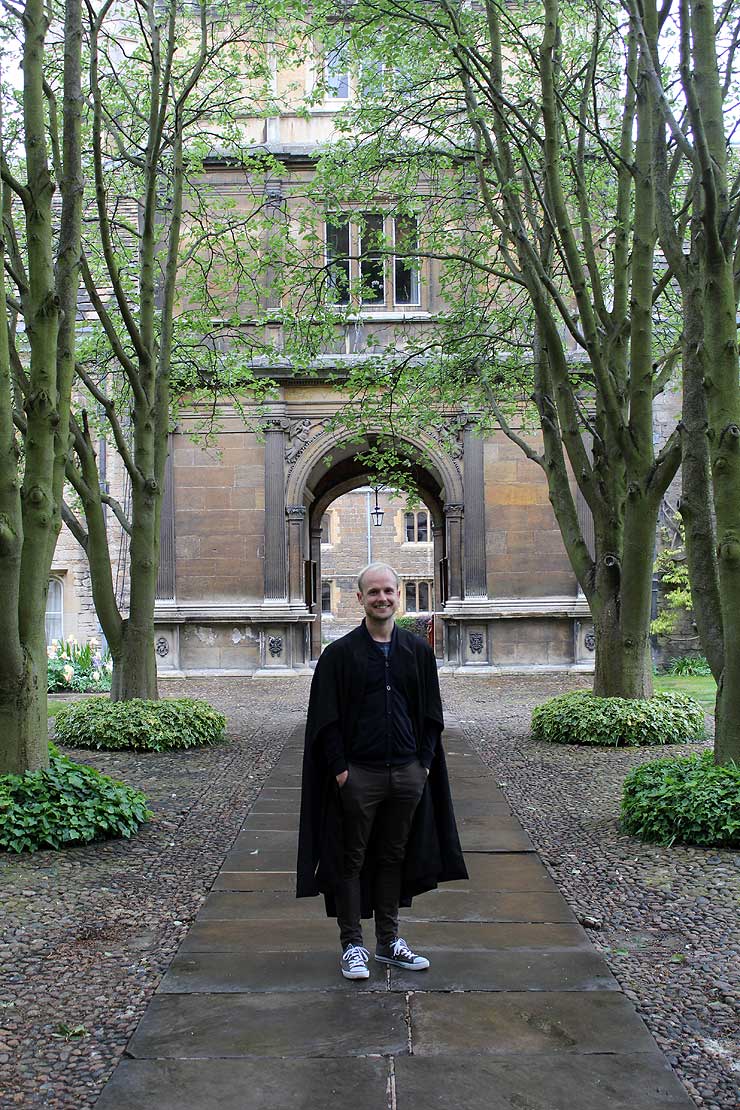
Massey philosophy student Nathan Hawkins at Cambridge University
BRICKS OR PIE? - BIG QUESTIONS WIN GATES CAMBRIDGE SCHOLARSHIP
There is a standing joke between Nathan and I whenever we are engaged with a third party or more in conversations about philosophy and the meaning of life etc ...... I often joke at an opportune time (which is usually when Nathan has stated some idea that he has plucked from the stratospheric recesses of his mind) that of course "I taught him all that he knows."But of course the truth is that Nathan talks and I struggle keep up as I take notes." Read on:
"Brick wall or sliced pie? It maybe a crude analogy, but it
captures how we might understand the structure of the Universe, says
Massey University Bachelor of Arts graduate Nathan Hawkins. He is about
to embark on doctoral research on the topic at one of the world’s top
philosophy departments.Last month he was selected for a 2017 Gates Cambridge Scholarship (established by the Bill and Melinda Gates Foundation) to support his PhD studies in philosophy and formal logic at Cambridge University, one of 55 from more than 5000 top applicants around the world. It’s his second such scholarship – he’s currently completing a Master of Philosophy at Cambridge with the support of a separate 2016 Gates Cambridge Scholarship, having just completed his masters at Massey’s School of Humanities.
From studying philosophy by distance through Massey University from his Whangarei home last year to gaining two prestigious Gates Cambridge Scholarships, Mr Hawkins explains via Skype from the revered British university how fundamental questions about the Universe might be explained by logic.
BRICKS OR PIE SLICES?
“The wall is derived from its brick-parts, but the slice-parts are derived from the pie. We might then wonder, which is the case with the universe? Are the parts of the universe fragments of a unified whole, or is the universe the sum of its primitive building blocks?”
A universe of multiple fundamental building blocks (the wall) is the philosophical position of Pluralism, while the fragmented universal whole (the pie) is its opposite, Monism. In the 20th century Pluralism has largely been assumed to be true, although recent discoveries in quantum physics have led to this assumption being questioned, he explains.
The way we answer this question affects our understanding of the workings of reality – is everything interconnected or is it all loose and separate? In other words, does the world consist of gunk or junk? (Both are valid philosophical terms used to describe different consequences of the competing theories). The debate between the two positions plays out in the philosophical field of metaphysics, although it draws heavily on evidence from physics, mathematics, and logic, Mr Hawkins says.

MATHS LINK TO PHILOSOPHICAL JOURNEY
For the 36-year-old British-born New Zealand citizen who married Kiwi Charlotte Hawkins (nee Smith), his exploration encompasses more than just the physical dimensions of what we call reality, but includes maths, ethics and divinity.
The lure of philosophy is, he says, that it “questions the things we think we know, in order to examine the foundations of those ideas and see whether or not those beliefs are reasonable. I’m peeling back layers of assumption to the nub of the issue and asking – is reality fundamentally complex?”
Mr Hawkins – who graduated from Massey with a double major in maths and philosophy – says he must develop his own logical language as a precursor to his PhD. This involves creating a new alphabet, rules of grammar, the intended meaning of logical sentences, and the principles that govern truth in the language, the groundwork for which he’s done in his near-completed Cambridge masters.
Enter Set Theory (the theoretical basis of all mathematics), Predicate Calculus (the logic of objects, their properties, and their relationships), Modal logic (the logic of what is possible and what is necessary) Quantum Entanglement and host of other mind-boggling terms. “We have certain ideas about reality – I believe that the world is a complex, interacting whole but I want to see if I can model that to see if that idea makes sense in terms of structure [maths and logic].”
CAMBRIDGE CONVERSATIONS HAVE 'WOW' FACTOR
He says being at the University of Cambridge, home to past philosophy greats – including Bertrand Russell and Ludwig Wittgenstein – has a distinct Harry Potter feel to it. He’s based at Gonville & Caius (pronounced ‘keys’) College, founded in 1348 and one of 31 colleges at the university, which celebrated its 800th anniversary in 2009. It’s also the college of celebrated theoretical physicist and cosmologist Stephen Hawking, who Mr Hawkins has seen eating in the dining hall, where all the members must wear black academic gowns.Another cool aspect of being a Cambridge scholar is the fascinating, if surreal, conversations. Forget the weather – from the scientist developing ink that collects solar energy so you paint your car and just go, to the woman researching how to turn off the chemical trigger that causes our brains to age, another training fruit flies to obey external commands and the pioneering PhD astrophysicist living on packaged foods to prepare for his one way trip on the Mars One mission and is “super excited to get blasted off to Mars and never come back” – small talk at Cambridge can be other-worldly, literally.
And while his own research might seem a tad esoteric, he maintains the study of philosophy is enriching and rewarding.
“Philosophy is something a lot of people can do and enjoy – it’s self-reflection, it’s contemplating the mystery of our own existence,” he says.
BOOSTING CRITICAL THINKING
Philosophy also helps develop critical thinking skills that not only “help people not be duped by advertising” but can fortify us for societal challenges. “We are entering time of political demagoguery and unique economic challenges where we need to think outside the box and find fresh answers for difficult questions.”Mr Hawkins’ former lecturer Dr Adriane Rini, from the School of Humanities, says winning admission to the Cambridge PhD programme “is itself a terrific recognition of Nathan’s abilities. The Gates Scholarships are extremely competitive. Excellent research is the first consideration, but the Gates also requires evidence that recipients are ‘using their intellectual gifts to make the world a better place’.”
She says her former student never shied away from the hard stuff in his scholarship, and is a true Massey success story as all of his studies were as a distance student. Mr Hawkins’ recognition as one of the world’s top philosophy students is something she and her colleagues “and the philosophers at all the other New Zealand universities” will be celebrating, she says.
Mr Hawkins starts his PhD in October on the same day his first child is due to be born, a coincidence perhaps and one he may just see as a signal of the “internal relatedness of all things.” "
Subscribe to:
Posts (Atom)