Wednesday, April 20, 2016

______________________ SOUTHERN SOJOURN (1) ______________________

Three weeks ago we journeyed to the deep south of the South Island of New Zealand. This province of Southland is a rugged, gnarly, hunkering down kind of place. It has its own special time in the sun during high summer yet the winds from Antarctica are only briefly sleeping.

Hold a sharp, jagged, rainy, raw, primeval pounamu (greenstone) in your warm hand - that's the feeling of living close to this primordial land.

The titanic force unleashed at the bottom of a waterfall is an apt metaphor for the forces that created this majestic landscape of Fiordland.

Rich vegetation clings in impossible places on colossal walls of rock shrouded by mist and cascading waterfalls.

A road is like a scar in this pristine part of our land. I would love to ride through this area on a horse. It would give more time to commune with the stunning surroundings, to feel its rhythms, to hear the land breathe and to camp under the stars.

Sea, sky, mountains, rivers, clouds, mist, valleys of golden tussock waving in the wind. All of these primal elements are amplified in these southern lands. This creates a perspective, a space for contemplating ones place in the scheme of things. It's a place to return to again and again.

Tuesday, April 19, 2016

'AUTUMN LEAVES' A SIMPLE CANOE YAWL FROM CHESAPEAKE LIGHT CRAFT BY A GENIUS OF A SMALL BOAT DESIGNER NAMED JOHN HARRIS

Shipmates it's not often that I am at a loss for words. Indeed from time to time when either speaking or writing it would be instructive for me to observe the old adage that 'Sometimes Less Is More'. This beautiful work of art has 'More In Less' than I have seen in a long, long time. She is an absolute epiphany of simplicity.

She is the 18 foot canoe yawl 'Autumn Leaves' designed by John Harris from that well known boat design and kit company Chesapeake Light Craft. The inspiration for her design has its genesis in that long tradition of wonderful canoe yawls from the Humber Yawl Club in the UK where such creative spirits of small boat design and voyaging as Albert Strange and George Holmes et al sailed, designed and had their being.

 'Autumn Leaves' is featured in the Latest Wooden Boat magazine (April 2016) ..........


..... she floats in 8 inches of water for crying out loud! Has twin bilge boards! The hull can be completed in two weeks! She has oodles of room with only 5 foot beam!!!!

Well, shipmates you can change my name by deed poll to Mizzen Top if my old eyes aren't just misting up and the old tickers not skipping the odd beat everytime I lay my eyes on this quirky little paragon of canoe yawlishness .........

You can read more about Canoe Yawls here:   http://www.canoeyawl.org/

It is very rewarding to go to the 'Designs' list (Click on ' + Designs by Designer tab) on this site to view canoe yawl designs that have been created for over 100 years.


" I've always been afflicted with Canoe Yawl Madness.  To me, a "canoe yawl" isn't just a design type; it's a self-contained small boat cruising philosophy.  According to this philosophy, skilled boatmen (and women) move their little boats along the coastline in all weather, artfully playing wind and tide to make passages without the stink and clamor of an internal-combustion engine. To watch someone make their anchorage under sail and oar is as lovely and fulfilling as watching Yo-Yo Ma play the cello." - John Harris.

Saturday, April 16, 2016

________ Cassandra - Ron Swanson Designed 'Carmen Class' Sloop ________

'Cassandra' - 30ft Ron Swanson Designed 'Carman Class' Sloop

Well shipmates when I do my circumnavigation it will be in a boat of this or similar design. This New Zealand built and owned yacht is the 'Cassandra'. She has a New Zealand sister ship 'Castanet' that was campaigned during the 1960's and was runner up to the famous 'Rainbow II' in the 1969 Sydney Hobart yacht race. She was designed by the Australian yacht designer Ron Swanson. The design is now over 40 years old and in those years this design has been proved both in ocean racing and in high latitude cruising. Her dimensions are approximately 30 feet over all, 24 feet on the water line, 9 foot beam with a 5 foot draft.

Cassandra and Castanet have two other famous sisters as well. One is the 'Cadence' which won the 1964? Sydney Hobart race and the 'Carronade' which completed a brave Cape Horn passage (again in the 1960s)which included a capsize in one of the most dangerous places for sailors on the planet.
One of the keys to the racing success of this design was its ability to maintain consistently good hull speeds in a wide range of conditions. The cruising success of this design is its sea kindly attributes, flush deck, long keel and its strong construction. Incorporated with good load carrying ability, good accommodation for its size, manageable sail area and good turn of speed it would be a good choice for an extended cruise - if you were looking for something small and relatively inexpensive.
The Cape Horn passage is told in Des Kearns book 'World Wanderer - 100,000 miles Under Sail."

"On the 26th March, 1967, just 500 miles from Cape Horn we were awed by what we saw and heard 'beyond the common experience of men'......... Carronade was long past the point of no return and fast bringing up the latitude of the Cape. At the change of watch I remarked to Andy that the Southern Cross was directly overhead. Craning his neck to see it, he said quietly, "Yes we're a long way south." The barometer had been falling for three days without a change in the weather. We had been lucky till then but now silently scanned the weather horizon waiting for the contest to begin. The barometer stood at 28.6, a quarter of an inch from the end of the scale; we shook with uncertainty and tenseness - waiting for the unknown, men fear most. It happened quickly...................

 'Carronade' Rounding Cape Horn 1967 - Painting by Jack Earl
 
............. Cape Horn stands within one of the most inhospitable, loneliest and treacherous pieces of water on our planet. Once in the golden age of sail, before the creation of the Panama Canal, it was the only route between the Pacific and Atlantic oceans. This area is the graveyard of over 800 ships and 10,000 sailors.

The crew of Carronade were three brave young men who rounded in 1967 but paid the price with a complete capsize in a hurricane - which luckily didn't dismast them - Its a wonderful story of skill courage and youthful adventure. 

Thursday, April 14, 2016

_______________ GARDEN TREASURES (5) - SISSINGHURST ______________

Sissinghurst's garden was created in the 1930's by Vita Sackville-West, poet and gardening writer, and her husband Harold Nicolson, author and diplomat. They were a part of what was known as the 'Bloomsbury Set'.

If you would like to know  the history of Sissinghurst Castle Garden and the lives of its creators there is a very good succinct description here:


I have nothing to add to Wikipedia's good coverage except to comment on an intriguing aspect of the source of the creative spirit which drove one of the gardens creators (Vita), which I will do at the end of this posting.

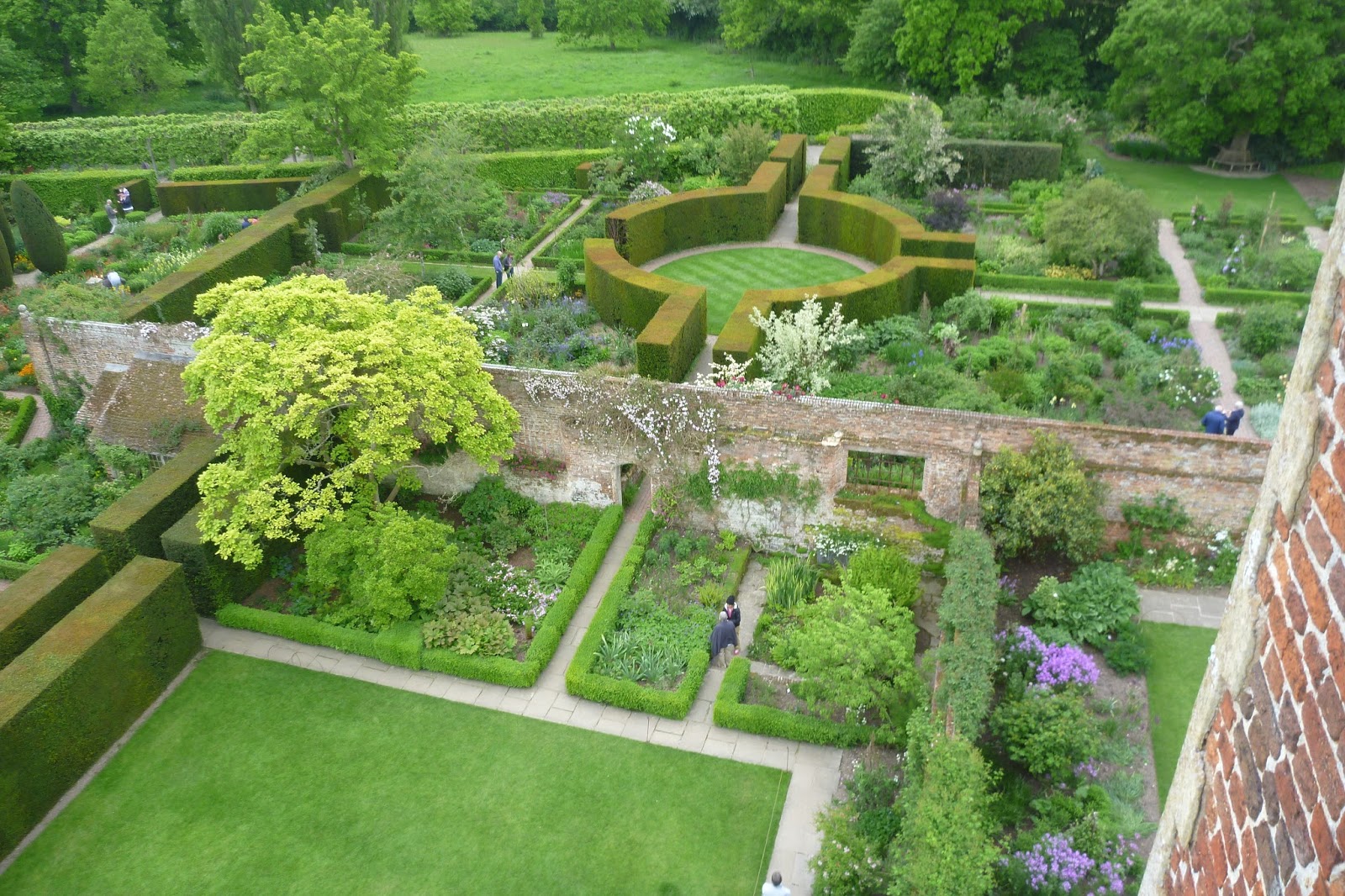
Great views were obtained by climbing the tower (first photo) which had a number of levels, one of which was Vita's retreat and writing room.

"It is necessary to write, if the days are not to slip emptily by. How else, indeed, to clap the net over the butterfly of the moment? for the moment passes, it is forgotten; the mood is gone; life itself is gone. That is where the writer scores over his fellows: he catches the changes of his mind on the hop. Growth is exciting; growth is dynamic and alarming. Growth of the soul, growth of the mind" - Vita Sackville-West (1892 - 1962)


One of the gardens 'Rooms' is the famous 'White Garden'. Of course moi went looking for a coloured flower and promptly found one - yes I know, a bit perverse, but there you are, it's my Jack in the Beanstalk gene.
A classic English garden feature - vibrant plantings facing the sun beneath a sheltering high brick wall.

The free standing tower I am photographing from was once part of a surrounding quadrangular wall surrounding a central 'Keep'.

"I sing the cycle of my country's year,
I sing the tillage, and the reaping sing,
Classic monotony, that modes and wars
Leave undisturbed, unbettered, for their best
Was born immediate, of expediency"- Vita Sackville West

"The country habit has me by the heart,
For he's bewitched for ever who has seen,
Not with his eyes but with his vision, Spring
Flow down the woods and stipple leaves with sun,
As each man knows the life that fits him best,
The shape it makes in his soul, the tune, the tone,
And after ranging on a tentative flight
Stoops like the merlin to the constant lure" - Vita Sackville West

"She walks among the loveliness she made,
Between the apple-blossom and the water—
She walks among the patterned pied brocade,
Each flower her son, and every tree her daughter" - Vita Sackville West

"Growth is exciting; growth is dynamic and alarming. Growth of the soul, growth of the mind; how the observation of last year seems childish, superficial; how this year — even this week — even with this new phrase — it seems to us that we have grown to a new maturity. It may be a fallacious persuasion, but at least it is stimulating, and so long as it persists, one does not stagnate.
I look back as through a telescope, and see, in the little bright circle of the glass, moving flocks and ruined cities" - Vita Sackville West

"I suppose the pleasure of the country life lies really in the eternally renewed evidences of the determination to live. That is a truism when said, but anything but a truism when daily observed. Nothing shows up the difference between the thing said or read, so much as the daily experience of it" - Vita Sackville West

"It isn't that I don't like sweet disorder, but it has to be judiciously arranged" - Vita Sackville West

"The more one gardens, the more one learns; And the more one learns, the more one realizes how little one knows" - Vita Sackville West 

On the death of Vita's father the beloved family estate Knole House that she loved with a passion was not inherited by Vita. The usual English aristocratic inheritance customs of the time were followed by the Sackville family. These customs prevented Vita from inheriting. Knole House followed the title and was bequeathed by her father to his NEWPHEW! Charles who became the 4th Baron of Knole House. This was a bitter blow to Vita.

Despite this reality Vita's creative spirit went on to build with her husband Harold Nicolson a thing of great beauty........ Sissinghurst - A truly magnificent gardening legacy and philosophy that is now administered by the National Trust in perpetuity for the enjoyment of all. It is this tale of a phoenix of sorts arising from the ashes of great disappointment that I find both inspiring and moving.


Tuesday, March 22, 2016

__________ GARDEN TREASURES (4) - GREAT DIXTER GARDENS _________

The graphic artist Maurits Cornelis Escher said: 

“We adore chaos because we love to produce order.”

 At Great Dixter Gardens I saw chaos and order together in a wonderful living paradox.

'Great Dixter is a house in Northiam, East Sussex, England. It was built in 1910–12 by architect Edwin Lutyens, who combined an existing mid-15th century house on the site with a similar structure brought from Benenden, Kent, together with his own additions. It is a Grade I listed building. The garden, widely known for its continuous tradition of sophisticated plantsmanship, is Grade I listed in the National Register of Historic Parks and Gardens.

The original Northiam house, known as Dixter, dating from the mid-15th century, was acquired by a businessman named Nathaniel Lloyd in 1909. He had a 16th-century house in a similar style moved from Kent and the two were combined with new work by Lutyens to create a much larger house, which was rechristened Great Dixter. It is a romantic recreation of a medieval manor house, complete with great hall, parlour, solar and yeoman's hall.

Lloyd and Lutyens began the garden at Great Dixter, but it was Lloyd's son Christopher Lloyd, a well known garden writer and television personality, who made it famous. The garden is in the arts and crafts style, and features topiary, a long border, an orchard and a wild flower meadow. The planting is profuse, yet structured, and has featured many bold experiments of form, colour and combination. The garden is currently managed by Fergus Garrett, who worked closely with Lloyd up until his death in 2006 as Head Gardener and introduced a number of innovations into the planting scheme.'

I am very much a non gardener, so it is difficult to make a lot of informed technical comments regarding the finer points of what I saw. But as the great gardening expedition rolled on I got to appreciate and know a little more. I liked Great Dixter a lot. Its pattern of plantings seemed more relaxed and less formal than say Hidcote Manor. There was a feeling of abundance and plenitude. Radiant chaos. A celebration of colour.

Large clusters of plantings in pots provided inspiration for our own garden.

Paths, hedges, walls and the vibrancy of the flowers made each garden room a place of intimacy and wonder.

Clusters of terracotta pots alive with various contrasting foliage added interest and delight.

On the left the old baronial hall, to the left the Oast house and the old barn.

An archway through a well manicured hedge entices you on as you explore.


Topiary lived alongside generous flower beds.

I was quite taken by this new garden seat and took a number of photographs. I liked its chunky simple lines and no nonsense design. When I have the time I am going to build one.

Box hedges planted among the flower gardens.

Agricultural students from all over the world come to Great Dixter to work. Here some of them  were gathering some cacti for a display.


The sunken garden with its pond by the old barn.

"Meadow Gardens" were a feature of some of the gardens we visited. These are areas of grass or wilderness left to grow in their natural state.

There was something slightly Wind in the Willows - Toad Hallish about the buildings. If I had come across Toad, Ratty, Mole and Badger strolling together in the grounds, or if I had seen a very large motor car with Toad behind the steering wheel careering up to the old Manor I wouldn't have been the least bit surprised!

Having a meadow garden I guess means less weeding?

A beautiful cluster of pots around the entrance to the main hall.

The painter Harlan Hubbard writing in a quiet book of a quiet, contemplative life wrote:

" The slanting sun is warm, the sky above the tawny earth is of deepest blue. The gardener harvests much that was never planted"

As a builder of boats, I understand this. In my opinion this is the deeper meaning of the gardens that we viewed. Both the tangible and intangible insights of the journey of creation are as important as that which is created.


Monday, March 21, 2016

Ngataki Classic Yacht Race


My good friend Ben emailed me this Utube video of the famous yacht Ngataki sailing on Aucklands beautiful Waitamata Harbour. Thanks Ben.

Ngataki is an important part of New Zealands growing yachting hertitage. Ngataki and her builder  are also a symbol of the 'Can Do' or 'Number 8 Wire' Kiwi attitude to life. I have posted extensively about Johnny Wray and his yacht Ngataki before. You will find some of these posts here:

http://yachtee.blogspot.co.nz/search?q=ngataki


Wednesday, March 16, 2016

____________ ABBEY CAVES, A CELLPHONE, JORIT AND ME _____________


Socrates said,  “The children now love luxury. They have bad manners, contempt for authority; they show disrespect for elders and love chatter in place of exercise.” 

When it comes to the continual put down of young people this quote shows that not much has changed since 399 BCE. As a teacher of over forty years my experience has for the vast majority of times been the complete opposite to Socrates. For the minority of times where authority and the wisdom of the status quo is challenged I have always seen this as healthy and normal, part of the rhythm and renewal of things. It was something I did myself when I was young. As for bad manners and disrespect, of course young people indulge in this sort of behaviour - so do adults, we aren't that much different in that regard. Anyway here's a little story about thoughtfulness and good manners that I experienced recently.

Last week as I walked into the lounge I met Jorit a young German tourist who was tapping on the window. Jorit had just visited Abbey Caves, a tourist destination not far from our house. He had hitch hiked to the caves in a silver Toyota driven by someone who lived in the area who looked about 70 years of age and had spent 7 years living in the Jersey Islands - this being the sum total of information he had gleaned. Jorit had lost his cellphone and thought he probably lost it in the elderly gentlemans car. Jorit wanted to know if I knew this man. I didn't, but I gave Jorit some simple logical advice that anyone else in the situation would have given, showed some interest in his travels around New Zealand, wrote down his email address, wished him luck in his search and sent him on his way.

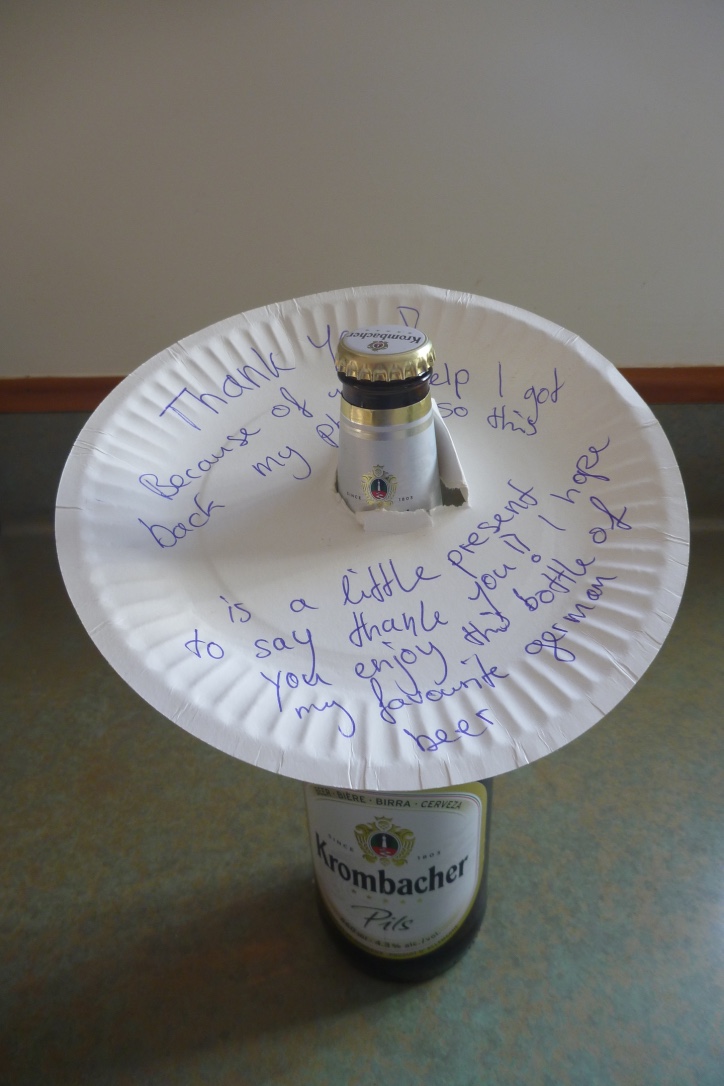
The next day I found this on the doorstep:


The message says:

"Thank you! Because of your help I got back my phone, so this is a little present to say thank you! I hope you enjoy this bottle of my favourite German beer."

Jorit must have gone to some trouble to deliver this to my door, considering he had to hitch hike to Abbey Caves.

I emailed Jorit and thanked him for his thoughtfulness. So Socrates you miserable old curmudgeon, don't ever tell me that all young people have bad manners and show disrespect for their elders; generalizations are the great mistakes of philosophical argument. 

..... and by the way, the German Beer was absolutely great!