Monday, April 25, 2016

______________________ SOUTHERN SOJOURN (4) ______________________

Traveling south from Queenstown to Kingston - Lumsden - Te Anau - Milford Sound - back to Te Anau - South through Manapouri - Tuatapere - Riverton - Nightcaps - Drummond - Gore - Invercargill - Bluff - then North East to the Caitlins (Coastal area between Bluff and Balclutha) - then North to Balcutha - Dunedin - Palmerston - Ranfurly -  Naseby - St Bathans - Alexandra - Clyde - Cromwell - Arrowtown - Ending in Queenstown.
Traveling south to Riverton the road lead out on the coast. To the left is Fouveaux Strait. In the distance is the hinterland of Fiordland.
A somewhat hazy photo of Riverton from a lookout above the town.

The communal kitchen of our digs in Riverton. The Campsite is a converted school outdoor education centre. The commodious kitchen contained a wood fired cooking stove. It was a robust, honest place with a decor that was definitely circa 1950. By the look of the stack of firewood on the veranda the building retained its distinctive 1950s insulation properties as well.

The lounge / dining / living room was the old school hall now equipped with a large fireplace. It was richly furnished in nostalgia including Formica tables and chairs with shiny chromed legs exactly like the set I grew up with in Christchurch in the 1960s.

Various glass fronted display cases had riveting displays of old bottles and other paraphernalia.

I noted the very emancipated advice from a poster in the kitchen.
 
I thought that I had been dreaming but on investigation I found that the whinnying that I had heard all night actually came from this horse in the paddock across the road. This horse paced up and down in front of a small creek that stopped it from gaining higher ground where there were three of its companions. It intermittently stopped in front of the creek and vigourously nodded its head up and down but never took the risk and jumped. I watched and dreamed of saddling it up and with a short haired Border Collie dog, that I would name 'Footrot Flats' style, 'Dog' as a companion, riding off into the great back of beyond back country of New Zealand.

I liked Riverton a lot. It has an air of purpose and authenticity about it. It gets its own steady stream of tourists but not so many that this has changed the essential nature and look of the place - a loss that has been effected by the hordes of tourists in places such as Queenstown.

This small port has an interesting little fishing wharf.  We took a walk along the jetty among the crayfish pots and other fishing gear as one boat was unloading after being at sea for two weeks.

No doubt the builder had good and probably humourous reasons for naming this local yacht with the direct and expressive name 'Pig Iron'...... but the name is somewhat ironic (excuse the pun), because the yacht is built of sheet steel (either run of the mill steel or the more non - corrosive Corten steel) rather than iron which is something different again.

The local museum proudly told its history of both Maori and Pakeha discovery and settlement.

Southlands topiary is probably the best I have ever seen anywhere in the world and by far the most humourous!

Sunday, April 24, 2016

______________________ SOUTHERN SOJOURN (3) ______________________

Tuatapere lies on the scenic route from Lake Manapouri to Riverton. It is a small rural town of around five hundred people. You can read all about Tuatapere here : https://en.wikipedia.org/wiki/Tuatapere

While passing through we saw an interesting combination Shop / Museum / Tearooms / Dairy - (A dairy in NZ is a place where you can purchase many supermarket items including those staples loved by all over weight Kiwis: icecream, milkshakes and pies).

When we walked through the door we were greeted by the sound of that old crooner Jim Reeves coming from an old LP record spinning on an even older record player.
 
I could cope with Jim Reeves but I did wonder at the coat hanger dangling from the raised record player turntable lid that was festooned with key-less key rings.

On the pavement was obviously what the shop owner thought would be a great tourist draw card - Prams! A strategy that I guess worked as it made us curious and drew us in.

My father was production manager for Oxley Prams in Christchurch during the 1960s so I instantly recognised the style and the vintage. These prams were made by Vantage, a rival brand.

My dad would occasionally bring home pram wheels for us to use so we could make box carts (But that's an entirely different and future blog post).

Amongst the bric a brac and a very large old wood stove were a selection of home made jams. We bought a jar of strawberry and another of blackberry to spread on Northland toast.

While Christine negotiated the purchase of the Hokey Pokey ice creams I took a selfie. We congratulated ourselves on our restraint regarding the pies and milkshakes.


Friday, April 22, 2016

Thursday, April 21, 2016

______________________ SOUTHERN SOJOURN (2) ______________________

Close together on the scenic route between Manapouri and Riverton lie the Rakatu Wetlands and the  Redcliff Wetland Reserve. The Rakatu viewing shelter has two beautifully etched glass windows.

Wetlands are very important areas because they improve water quality, reduce the impact of flooding, support great concentrations of bird life and provide breeding areas for many fish species.

In Aotearoa New Zealand wetlands have a historical importance. Wetlands were a treasure trove for early Maori, providing flax for clothing, mats, kits and ropes, raupo for thatching and dried moss for bedding. The eels, fish and birds which lived there were a good food source and the feathers of birds like pukeko and bittern were used to adorn cloaks and other garments. Waterways were an important means of access by waka (canoe).

April, early Autumn in Southland means you wear a coat.

Wednesday, April 20, 2016

______________________ SOUTHERN SOJOURN (1) ______________________

Three weeks ago we journeyed to the deep south of the South Island of New Zealand. This province of Southland is a rugged, gnarly, hunkering down kind of place. It has its own special time in the sun during high summer yet the winds from Antarctica are only briefly sleeping.

Hold a sharp, jagged, rainy, raw, primeval pounamu (greenstone) in your warm hand - that's the feeling of living close to this primordial land.

The titanic force unleashed at the bottom of a waterfall is an apt metaphor for the forces that created this majestic landscape of Fiordland.

Rich vegetation clings in impossible places on colossal walls of rock shrouded by mist and cascading waterfalls.

A road is like a scar in this pristine part of our land. I would love to ride through this area on a horse. It would give more time to commune with the stunning surroundings, to feel its rhythms, to hear the land breathe and to camp under the stars.

Sea, sky, mountains, rivers, clouds, mist, valleys of golden tussock waving in the wind. All of these primal elements are amplified in these southern lands. This creates a perspective, a space for contemplating ones place in the scheme of things. It's a place to return to again and again.

Tuesday, April 19, 2016

'AUTUMN LEAVES' A SIMPLE CANOE YAWL FROM CHESAPEAKE LIGHT CRAFT BY A GENIUS OF A SMALL BOAT DESIGNER NAMED JOHN HARRIS

Shipmates it's not often that I am at a loss for words. Indeed from time to time when either speaking or writing it would be instructive for me to observe the old adage that 'Sometimes Less Is More'. This beautiful work of art has 'More In Less' than I have seen in a long, long time. She is an absolute epiphany of simplicity.

She is the 18 foot canoe yawl 'Autumn Leaves' designed by John Harris from that well known boat design and kit company Chesapeake Light Craft. The inspiration for her design has its genesis in that long tradition of wonderful canoe yawls from the Humber Yawl Club in the UK where such creative spirits of small boat design and voyaging as Albert Strange and George Holmes et al sailed, designed and had their being.

 'Autumn Leaves' is featured in the Latest Wooden Boat magazine (April 2016) ..........


..... she floats in 8 inches of water for crying out loud! Has twin bilge boards! The hull can be completed in two weeks! She has oodles of room with only 5 foot beam!!!!

Well, shipmates you can change my name by deed poll to Mizzen Top if my old eyes aren't just misting up and the old tickers not skipping the odd beat everytime I lay my eyes on this quirky little paragon of canoe yawlishness .........

You can read more about Canoe Yawls here:   http://www.canoeyawl.org/

It is very rewarding to go to the 'Designs' list (Click on ' + Designs by Designer tab) on this site to view canoe yawl designs that have been created for over 100 years.


" I've always been afflicted with Canoe Yawl Madness.  To me, a "canoe yawl" isn't just a design type; it's a self-contained small boat cruising philosophy.  According to this philosophy, skilled boatmen (and women) move their little boats along the coastline in all weather, artfully playing wind and tide to make passages without the stink and clamor of an internal-combustion engine. To watch someone make their anchorage under sail and oar is as lovely and fulfilling as watching Yo-Yo Ma play the cello." - John Harris.

Saturday, April 16, 2016

________ Cassandra - Ron Swanson Designed 'Carmen Class' Sloop ________

'Cassandra' - 30ft Ron Swanson Designed 'Carman Class' Sloop

Well shipmates when I do my circumnavigation it will be in a boat of this or similar design. This New Zealand built and owned yacht is the 'Cassandra'. She has a New Zealand sister ship 'Castanet' that was campaigned during the 1960's and was runner up to the famous 'Rainbow II' in the 1969 Sydney Hobart yacht race. She was designed by the Australian yacht designer Ron Swanson. The design is now over 40 years old and in those years this design has been proved both in ocean racing and in high latitude cruising. Her dimensions are approximately 30 feet over all, 24 feet on the water line, 9 foot beam with a 5 foot draft.

Cassandra and Castanet have two other famous sisters as well. One is the 'Cadence' which won the 1964? Sydney Hobart race and the 'Carronade' which completed a brave Cape Horn passage (again in the 1960s)which included a capsize in one of the most dangerous places for sailors on the planet.
One of the keys to the racing success of this design was its ability to maintain consistently good hull speeds in a wide range of conditions. The cruising success of this design is its sea kindly attributes, flush deck, long keel and its strong construction. Incorporated with good load carrying ability, good accommodation for its size, manageable sail area and good turn of speed it would be a good choice for an extended cruise - if you were looking for something small and relatively inexpensive.
The Cape Horn passage is told in Des Kearns book 'World Wanderer - 100,000 miles Under Sail."

"On the 26th March, 1967, just 500 miles from Cape Horn we were awed by what we saw and heard 'beyond the common experience of men'......... Carronade was long past the point of no return and fast bringing up the latitude of the Cape. At the change of watch I remarked to Andy that the Southern Cross was directly overhead. Craning his neck to see it, he said quietly, "Yes we're a long way south." The barometer had been falling for three days without a change in the weather. We had been lucky till then but now silently scanned the weather horizon waiting for the contest to begin. The barometer stood at 28.6, a quarter of an inch from the end of the scale; we shook with uncertainty and tenseness - waiting for the unknown, men fear most. It happened quickly...................

 'Carronade' Rounding Cape Horn 1967 - Painting by Jack Earl
 
............. Cape Horn stands within one of the most inhospitable, loneliest and treacherous pieces of water on our planet. Once in the golden age of sail, before the creation of the Panama Canal, it was the only route between the Pacific and Atlantic oceans. This area is the graveyard of over 800 ships and 10,000 sailors.

The crew of Carronade were three brave young men who rounded in 1967 but paid the price with a complete capsize in a hurricane - which luckily didn't dismast them - Its a wonderful story of skill courage and youthful adventure. 

Thursday, April 14, 2016

_______________ GARDEN TREASURES (5) - SISSINGHURST ______________

Sissinghurst's garden was created in the 1930's by Vita Sackville-West, poet and gardening writer, and her husband Harold Nicolson, author and diplomat. They were a part of what was known as the 'Bloomsbury Set'.

If you would like to know  the history of Sissinghurst Castle Garden and the lives of its creators there is a very good succinct description here:


I have nothing to add to Wikipedia's good coverage except to comment on an intriguing aspect of the source of the creative spirit which drove one of the gardens creators (Vita), which I will do at the end of this posting.

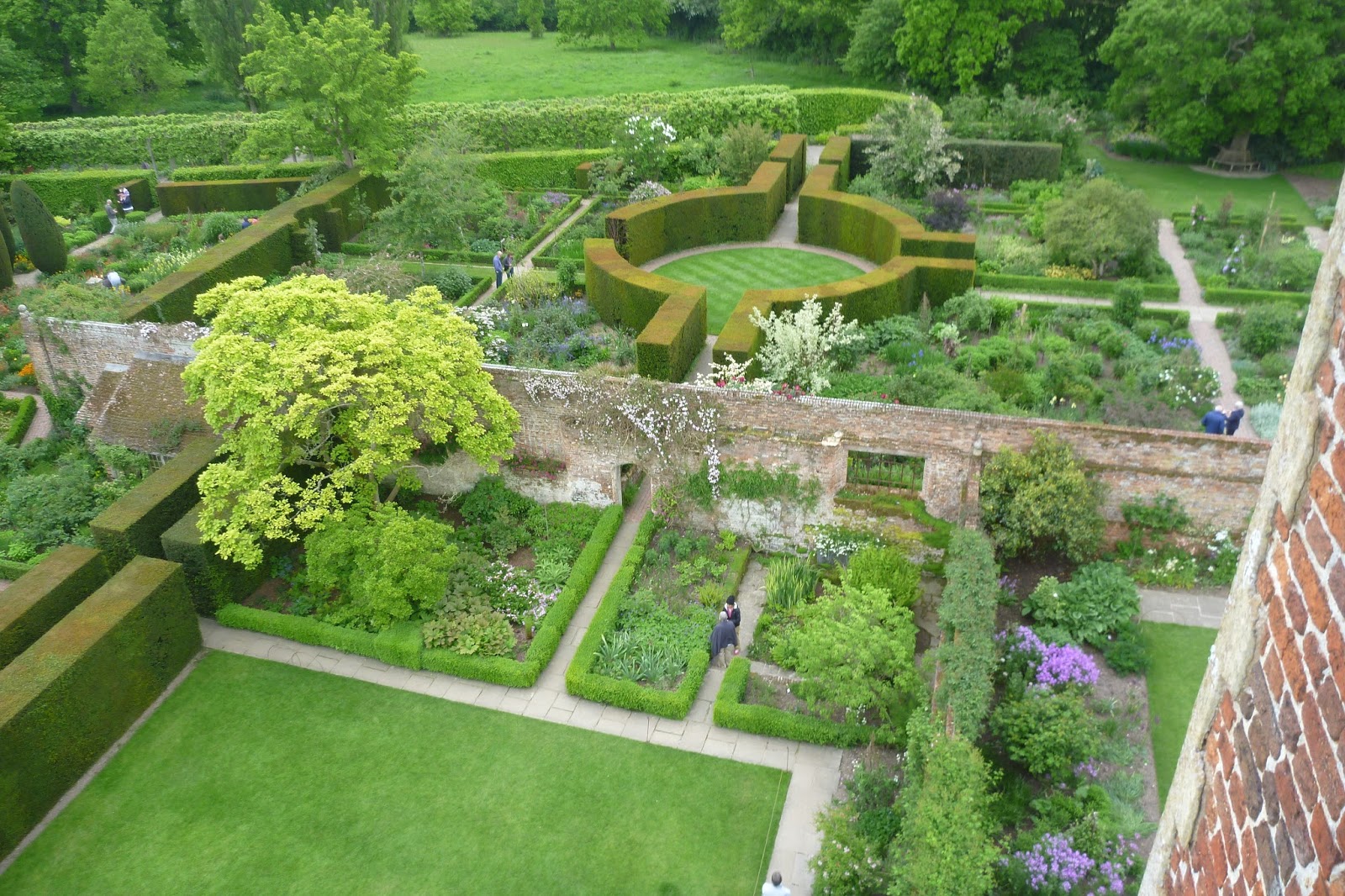
Great views were obtained by climbing the tower (first photo) which had a number of levels, one of which was Vita's retreat and writing room.

"It is necessary to write, if the days are not to slip emptily by. How else, indeed, to clap the net over the butterfly of the moment? for the moment passes, it is forgotten; the mood is gone; life itself is gone. That is where the writer scores over his fellows: he catches the changes of his mind on the hop. Growth is exciting; growth is dynamic and alarming. Growth of the soul, growth of the mind" - Vita Sackville-West (1892 - 1962)


One of the gardens 'Rooms' is the famous 'White Garden'. Of course moi went looking for a coloured flower and promptly found one - yes I know, a bit perverse, but there you are, it's my Jack in the Beanstalk gene.
A classic English garden feature - vibrant plantings facing the sun beneath a sheltering high brick wall.

The free standing tower I am photographing from was once part of a surrounding quadrangular wall surrounding a central 'Keep'.

"I sing the cycle of my country's year,
I sing the tillage, and the reaping sing,
Classic monotony, that modes and wars
Leave undisturbed, unbettered, for their best
Was born immediate, of expediency"- Vita Sackville West

"The country habit has me by the heart,
For he's bewitched for ever who has seen,
Not with his eyes but with his vision, Spring
Flow down the woods and stipple leaves with sun,
As each man knows the life that fits him best,
The shape it makes in his soul, the tune, the tone,
And after ranging on a tentative flight
Stoops like the merlin to the constant lure" - Vita Sackville West

"She walks among the loveliness she made,
Between the apple-blossom and the water—
She walks among the patterned pied brocade,
Each flower her son, and every tree her daughter" - Vita Sackville West

"Growth is exciting; growth is dynamic and alarming. Growth of the soul, growth of the mind; how the observation of last year seems childish, superficial; how this year — even this week — even with this new phrase — it seems to us that we have grown to a new maturity. It may be a fallacious persuasion, but at least it is stimulating, and so long as it persists, one does not stagnate.
I look back as through a telescope, and see, in the little bright circle of the glass, moving flocks and ruined cities" - Vita Sackville West

"I suppose the pleasure of the country life lies really in the eternally renewed evidences of the determination to live. That is a truism when said, but anything but a truism when daily observed. Nothing shows up the difference between the thing said or read, so much as the daily experience of it" - Vita Sackville West

"It isn't that I don't like sweet disorder, but it has to be judiciously arranged" - Vita Sackville West

"The more one gardens, the more one learns; And the more one learns, the more one realizes how little one knows" - Vita Sackville West 

On the death of Vita's father the beloved family estate Knole House that she loved with a passion was not inherited by Vita. The usual English aristocratic inheritance customs of the time were followed by the Sackville family. These customs prevented Vita from inheriting. Knole House followed the title and was bequeathed by her father to his NEWPHEW! Charles who became the 4th Baron of Knole House. This was a bitter blow to Vita.

Despite this reality Vita's creative spirit went on to build with her husband Harold Nicolson a thing of great beauty........ Sissinghurst - A truly magnificent gardening legacy and philosophy that is now administered by the National Trust in perpetuity for the enjoyment of all. It is this tale of a phoenix of sorts arising from the ashes of great disappointment that I find both inspiring and moving.